Tag Archives: schoollunchrecycling

Hastings: Astonishing First Year Results from We Future Cycle Program

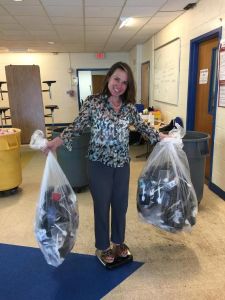
IMG_0258Can you imagine 110 times the amount of garbage as in this picture? Well, this is what Hastings-on-Hudson school district has not generated in the past year thanks the robust We Future Cycle recycling program it adopted last year. About 22 tons.

Thanks to the endless energy and support of Maureen Carabello, Treasurer, as well as the two head custodians in the elementary school and the middle/high school Hastings can look proudly upon major accomplishments.

Both buildings reduced their garbage so significantly that they reduced the number of dumpster by 50% and were able to renegotiate a $2000.00 reduction in their pick up cost.

Custodial staff was also able to reduce their plastic bag usage and purchases by 50% which is an expense often overlooked.

Truly an astonishing first year results. Hats off to Hastings-on-Hudson.

Research: Longer Lunch Periods Mean Healthier Eating and Less Waste

According to a new study published in the Journal of the Academy of Nutrition and Dietetics, students with 20 minutes or fewer to eat at lunchtime rarely finish their meal and make unhealthier food choices.

While most elementary school children have about 30 minute lunch periods in the U.S., some spend much of their lunch period standing in line waiting to get their lunch.  We often see students come to the source separation station to recycle and compost leftovers with only a few bites of their lunch consumed.  When we ask why they didn’t eat more sometimes they say they didn’t like the food; however just as frequently they will say “I didn’t have time to eat everything.”

[Read the full article here]

This response confuses school administrators, as it would seem that 30 minutes is sufficient for a child to each lunch.  However, we have observed that students spend a lot of their lunch period talking, as it is often the first opportunity during the school day that they can relax and talk with their friends.  Socializing often takes priority to eating!

The research – and We Future Cycle – offer recommendations about how to reduce lunchroom waste and to encourage healthier eating.  Designing lunchrooms and lunch schedules to reduce wait times on lunch lines, and to offer as extensive lunch periods as possible, are constructive ideas.  While recycling and composting is great, the best way to reduce waste is to not create it!

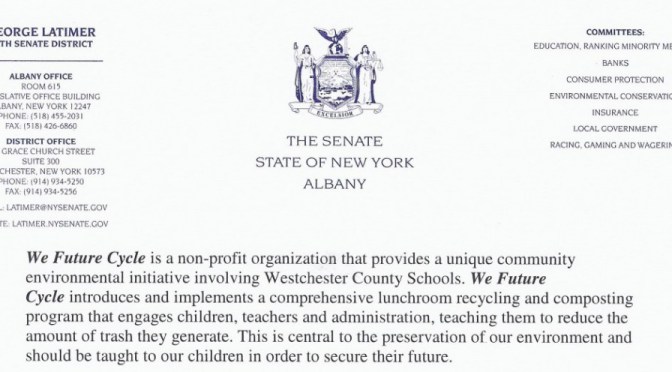
Senator Latimer supports We Future Cycle Program implementation throughout NY

We Future Cycle is honored to have its lunchroom recycling program endorsed by Senator George Latimer. He took time from his busy schedule to visit a We Future Cycle Recycling implementation at BMP Ridge Street School in Rye Brook, NY, and he has also met with our team to discuss grant opportunities.

Thank you Senator Latimer for your public support.

latimer letter wfc

How Much is Actually “a Ton of Garbage”?

Garbage costs money.  However only very few people actually know how much it costs and what a ton looks like. Very few of us think further then to the curb.

Let’s look at school garbage a little closer. A school with 830 students generated 23 large black bags of garbage every lunch, the total weight of those bags is 398.5 lbs.

This is what 23 bags look like. IMG_0258 Now that we know what about 400 lbs of garbage looks like, lets think about it.

A ton of garbage costs the tax payer around $80.00 to just dump it onto the tipping floor of the Incinerator, the big trash burning facility up in Peekskill. 400 lbs is a fifth of a ton.  So, imagine 5 times the amount you see, or 115 bags of trash. Clearly the $80 per ton does not represent the only cost of garbage. This material has to be put in bags, then brought outside into the dumpster, then loaded by workers into diesel fuel guzzling trucks (about 2.5 miles per gallon of diesel), driven to a transfer station, dumped there, then loaded onto large trucks and driven 50 miles up north to be dumped onto the tipping floor of the incinerator. And then it is burnt into our air. I get dizzy just looking at how often this material needs to be touched and handled for it “to go away”. It takes that much time and effort to “just throw something away”.

We just started the School lunch recycling program in this school and the kids sorted their lunchwaste into liquids, commingled, milk cartons, compost and trash. The results were astounding. unnamed

Out of the previous 398.5 lbs, only 8 lbs were actually non recyclable. That means that 98% of the material is recyclable.  So, “just throwing it away” is not just costing us a lot of money, but in fact, we use tax payer money to burn materials that we could easily sell for a profit. unnamed (2)
This is what 10 lbs of commingled looks like. Some math on the value of commingled. 1 ton of plastic PETE 1 sells from the Yonkers MRF for around $800. (the cost is market driven, oil dependent and is fluctuating). 10 lbs of plastic (to simplify this calculation, it is all the same resin) 2000 lbs of plastics sell for $800.00 10 lbs = $4.00 Milk cartons sell for $450 per ton. 30 lbs = $6.75 IMG_0278And this is what 15 lbs of milk cartons look like, we had two of these bags. And two full 5 gallon buckets with waste liquid weighing 74 lbs. That means we use fossil fuels to truck liquids 50 miles north just to burn them, rather then sending them down the drain? By far the heaviest was the food waste. 180 lbs of wasted food from 800 kids, plus about 50 lbs of untouched never opened food that was placed into the share basket. Clearly, a ton of garbage is a lot, but as you can see, only 2% of it is actually non recyclable.

So, our convenience to “just throw it away” costs us all dearly. Not just as hard cash but also at great environmental expense.

First Graders Write Heartwarming Thank You Notes for Bringing Recycling to Their School

We Future Cycle just finished implementing the recycling program at Blind Brook’s BMP Ridge Street Elementary School.

We just received these  heartwarming Thank You Notes from the 1st graders for bringing recycling to their school.

We are honored and very touched.

THANK YOU 1st Graders for such wonderful thoughts.

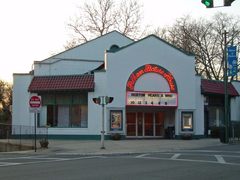
We Future Cycle’s Bash The Trash Documentary showing in Pelham Picture House on April 22, 6:30 pm

On April 22nd 2015 at 6:30, the curtain will rise to show the documentary filmed about the Bash The Trash Legacy Project created and supervised by We Future Cycle in the Colonial Elementary School in Pelham. We are so excited and hope you can all join us for this event.

maxresdefault-e1429033807574Also shown will be “Devide in Concord”, the tale of the battle to ban the plastic bottle.

The Pelham Picture house is located at 175 Wolfs Ln, Pelham, NY 10803.

Pelham’s Colonial School In The Pelham Weekly Newspaper For Making A Difference

Colonial Fifth Graders Challenge School To “Bash The Trash”

Colonial’s fifth graders recently challenged the school to “Bash the Trash” and go litterless at lunch, reducing the trash collected every day. Parents were urged to use recyclable containers for food and drink (containers that could be returned home, washed  and reused). At the end of the challenge, the fifth graders plan to tell the school how much the trash was reduced, based on data they collected. Their hope is to leave a “littlerless legacy” at Colonial when they graduate.

Please see full published “The Pelham Weekly” article here:

http://www.pelhamplus.com/news/schools/collection_b8f059da-ac9e-11e4-a787-2f29c82bf329.html

FiOS1 News Story on We Future Cycle Program in Hastings

We Future Cycle is proud to be featured on FiOS 1 News by reporter Christina Chiarelli, who was on site at Hastings’ Hillside Elementary School.  Ms. Chiarelli spoke with the school’s head custodian, George Giannone, aide Kim Osborne, and many students about how the program has dramatically reduced lunchroom waste.

As well, interviews with the students’ demonstrated how much they have learned about recycling from participating in the program!  Hands-on recycling and composting give kids a tangible understanding of how their actions have an impact on the environment.

Watch the broadcast by clicking here or on the image below:

Fios newscaster

WCBS AM 880 Covers Hastings-on-Hudson’s Implementation of We Future Cycle

Sean Adams of WCBS radio recently covered the We Future Cycle implementation at Hastings-on-Hudson schools, featuring We Future Cycle founder Anna Giordano, Hastings’ Hillside Elementary School Assistant Principal Farid Johnson, Facilities Director George Prine, and Food Service Director Alan Levin.

Read and listen to the WCBS AM 880 story here.

WCBS 880 image

Environmental Goals for Westchester in 2015, let’s do this!

With 2014 being such an incredible year we are looking forward to 2015 and the positive change it can bring to Westchester schools.

My personal wish list for 2015 is

1. Implementing We Future Cycle’s School Lunch and Building-Wide Recycling and Composting Program to 10 More School Districts in 2015, even if it is just in one pilot school per district. Implementing these programs is very do-able, but working with experts is critical to ensure a successful implementation. Results will speak for themselves and that will hopefully lead to district-wide implementation in many Westchester School districts.

Just imagine, if one school reduces its garbage from 22 bags per day down to less then 1/4 bag per day, what kind of impact this will have if 10 more districts will join the program. And just imagine all those students going back home to their parents and sharing their enthusiasm to save the world.

2. Creating the First Leaf and Food-Waste Composting Site in Westchester. So far, only very few communities are composting their leaves, most are trucking them to Rockland County at great expense in fossil fuel consumption, labor and heavy equipment on our streets. So far, no community is doing larger scale, organized food waste composting instead nature’s valuable resource is treated as trash, plastic bagged and burnt. The good news is that several communities are now studying how to solve this problem. We are proud to be on the forefront with them.

3. Integrating Sustainability Education into Curriculum. We have done numerous environmental projects with individual schools such as green writing contests, waste free snack education, TerraCycle Ambassador programs, kindergarten recycling sorting games and it shows again and again, that when students are made aware early of their personal ability to create environmental change, that the ripple effect through the community is amazing.