All posts by wefuturecycle

New Rochelle Middle School is Digging Soil To Combat Climate Change

New Rochelle Albert Leonard middle school students are digging soil, in a literal kind of way.

6th graders explored in We Future Cycle classroom sessions the connections between throwing food waste in the garbage and climate change. Learning about methane and leachate got their attention. Just thinking past the garbage can is eye opening for these students.

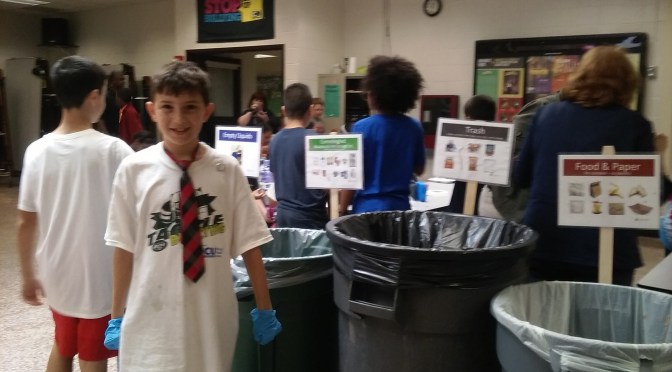
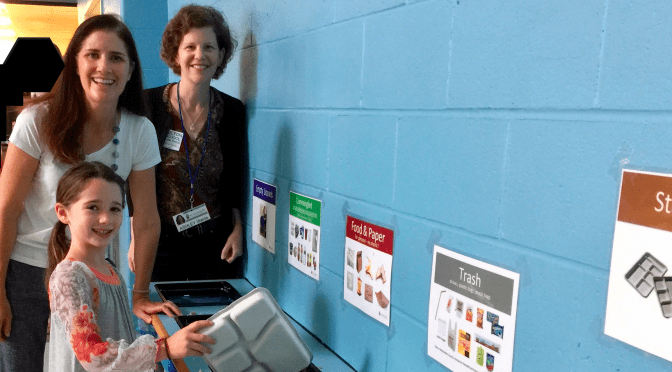
While New Rochelle’s entire student population is now sorting their lunch waste between Commingled Recycling, Food Waste and Trash, thus reducing trash by a whopping 97%, they have not quite learned what actually happens to the food waste.

In classroom presentations, student were walked through the chemical process of decomposition, they chuckled a bit when asked if the banana looks the same when it comes back out and they quickly got the concept of nutrients, water and energy being the basis for life.

Making connections between how the apple tree takes nutrients out of the ground to grow the apple, which in turn nourishes our body when we eat it, and how the left over  still contains many nutrients that could benefit the soil if put back, but creates havoc if treated as garbage and dumped in a landfill, was a completely new line of thought to all students.

Students had the chance to dig through soil samples, seeing and touching the difference organic matter made in soil samples. They were tasked to make determination in terms of water retention capabilities, nutrient content and how plants might like to grow in that particular soil. Social Studies questions were introduced for students to think about how a the quality of soil might affect the wealth of a country.

What started out with students looking somewhat puzzled at three soil samples on their desk, ended in some fabulous essays about why composting is so important to the survival of our world. Great job Albert Leonard students.


We Future Cycle Brings E-Waste Recycling Education to Schools to Improve Dismal 3% Cell Phone Recycling Rate

1 billion cell phones were produced in 2015, with a growth rate of 14% annually. A shocking number especially looking at the dismal recycling rate of 3%.

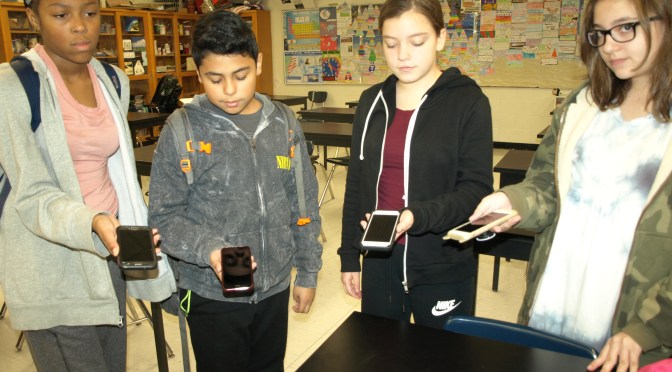
We Future Cycle is bringing E-Waste Recycling Education to Middle Schools in New Rochelle as part of the Science curriculum. Students were asked to raise one hand if they owned a cell phone, and both hands if they had changed their cell phone in the past 18 months. Every single student raised both hands!

Every cell phone contains valuable metals such as copper, tin, silver, gold, cobalt, nickel, aluminum and lithium, not to mention the rare earth minerals like Neodymium, Yttrium, Terbium, Cerium and Europium. Without these metals, there would be no handy device.

Students learned about mining techniques and the unbelievable environmental destruction that goes hand in hand with mining in countries with little or no environmental oversight.

Touching upon child labor in African cobalt mines, learning about mercury contamination in the Amazon while mining for gold and seeing pictures of nickel mines in Mozambique was hard for students. They recoiled in their chairs and some even pushed their ever present phone on their desk to the far corner.

Peru-Gold-Mining-AsnerConnecting students to the origin of the devices they are using is the basis for them to become global citizens and to become engaged in responsible practices.
Students learned about the dismal recycling rate of only 3%, and they all admitted that they have drawers full of antiquated devices not knowing what to do with them.

New York State now requires all consumers to recycle e-waste in a responsible manner. It is against the law to discard a broken computer in the trash. Cell phones however are so small that it is easy to slip into the kitchen trash, but consumers are literally discarding gold!.

According to the EPA : 1 million cell phones contain 75 lbs of gold, 33 lbs of palladium, 35,274 lbs of copper and 772 lbs of silver, just to name a few. 

Recycling metals reduces its environmental foot print by a whopping 90-95%

Recycling cell phones is easy! Just drop them off at any retailer, they are by law required to take them back at no charge. To protect your privacy, take the SIM and other memory chip out and cut it in half.


New Rochelle ALMS Students Learn What Happens When They Flush “gasp”

OLYMPUS DIGITAL CAMERA
Learning about Waste Water Filtering

Students looked somewhat bored when they heard that they will learn about water and one student piped up smartly :”I know, I know it’s H2O, has a Ph of 7 and can exist in liquid, solid and gaseous state”

With a smile, I asked that student where her water comes from and after a fraction of hesitation came a much more subdued “out of the faucet”…… phrased more like a question than a statement. And she was suddenly wide awake and much more interested.

New Rochelle School District understands that environmental literacy cannot stop at the lunchroom recycling but should be carried throughout the curriculum to have students internalize that their every day actions have a big impact on the environment. Albert Leonard Middle School has invited Anna Giordano into the classroom and students are learning as a curriculum add-on about the environmental foot print of something as mundane as turning on the faucet.

Walking students through where their drinking water comes from, what steps it has to go through before it arrives conveniently at their kitchen faucet was quite eye opening for them.

A collective gasp was heard upon being asked what they think happens when they flush.

Students took a second to process the word “Bio Solids” but quickly chuckled. Seeing pictures of the New Rochelle Waste Water Treatment plant put into prospective the monumental task it is to keep society going.

We covered the steps in the Waste Water Treatment plant and how communities have implemented waste water to drinking water programs. Students shuddered by the thought of former toilet water making its way back into the faucet, but realized at some point that reality requires this and it is ultimately cheaper than ocean water desalination.

And learning about the marketing hoax of bottled water was the true eye-opener for students. Can you imagine 7th graders coming up to express thanks for teaching them about water? Well, it was heartwarming and truly special!


Inspiring The Young At Heart To Make A Difference

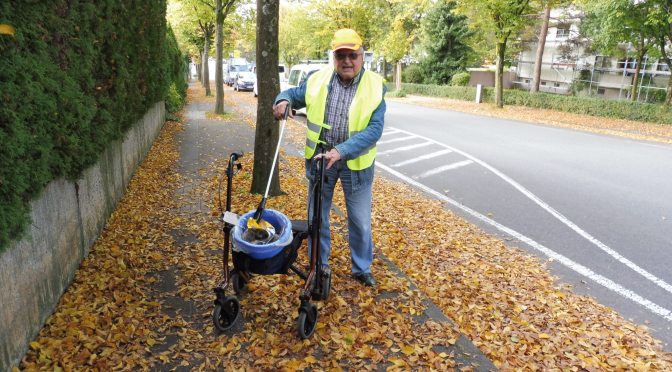
With pleasure we received a note from an avid reader of our blog about how our recent blog post about picking up litter on the daily dog walk inspired him to do the same.

Making a difference is all about seeing a problem and doing something about it. We applaud this Young at Heart activist for demonstrating that any age is the right age to pitch in.

OLYMPUS DIGITAL CAMERA

https://wefuturecycle.com/2017/06/09/two-dogs-one-walk-around-the-block-and-three-bags-of-trash/

New Rochelle 6th Grader is Taking Action For The Environment

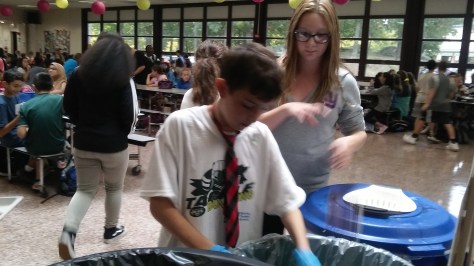
Meet Jonah, a 6th grader at the Albert Leonard Middle School. He is a fire cracker for the environment and makes it his business that the We Future Cycle recycling system is working properly. He explains that climate change is real and if we are not starting to act upon it, we will be in trouble. And Jonah acts on it! Single handed he recruits classmates to help him build a cleaner school world. He made up flyers and posted them around the school and when he gets to the lunchroom, he eats quickly and then dons on gloves to supervise a recycling station.

This kind of above and beyond attitude did not go unnoticed by the school administration and Jonah received the “Upstander of the Week” award by Principal Barnes and Assistant Principal Goldberg. He also received a T-Shirt to go with that award. Big applause, this is what it takes to make a difference.

Thank you Jonah for your personal commitment and your drive to make this a better world.

20170919_123731

Open House in White Plains Elementary School Proves that Students Change Communities

Last night, We Future Cycle hosted an informational table at the White Plains Mamaroneck Avenue School at the Back -To- School Open House. Talking to parents showed that even the K students with only about 10 days of lunchroom sorting under their (tiny) belts brought the information about recycling home and some even effected change already. It was heart warming to hear parents say how excited their kids were about being part to save the world. One mother shared with me that her son told her on day two that she needed to get another bin to sort out recyclables (which she did)

One father shared with me that the favorite word of his brand new kindergarten student is commingled and he sits at dinner and identifies the different materials he sees.

To give some background, White Plains School district hired We Future Cycle in 2015 to implement the recycling program in its elementary schools, moving into the middle schools by 2016 and now starting the HS school. Administration at MAS has been outstanding supporters of this program and this percolates through the building. Students are lining up to help at the recycling stations, students are signing up to help sweep and wipe tables, every single classroom has a recycling stations and while walking the building it was heartwarming to see that every single bin was perfectly sorted.

This proves that environmental education in schools can change communities. It teaches responsibility and personal commitment. All life long lessons. Hats off to MAS students for being the change we want to see in this world.

This slideshow requires JavaScript.

New Rochelle High School: Changing the world…3500 students reduce garbage by 90% through sorting.

New Rochelle High School is the largest HS in Westchester County New York, it is more like a college campus with sprawling hallways and mind-boggling amounts of students spilling out of classrooms when the bell rings. 3 cafeterias are on campus feeding these youngsters and until recently were generating a whopping 100 large bags of garbage e.v.e.r.y…s.i.n.g.l.e…l.u.n.c.h ! Filling up 3 dumpsters to the brim just from lunch, and another two large dumpsters from night clean.

New Rochelle School District has embraced the We Future Cycle Recycling Program and steps were put into place over the summer to include the High School. Principal Richardson admitted that he was beyond skeptical about how this program could possibly work in a huge building like the High School. He however vowed his full support.

In order for a recycling program to work, one has to address all players in the building. We Future Cycle did presentations to students, custodial staff, and security personal to outline just how we are all affected by garbage and how simple changes of behavior can make a HUGE difference. Putting the new knowledge to action, students started to sort their waste in the different cafeterias and learned that by simply sorting into excess liquid, commingled recycling and food waste for compost, 90% of the waste is captured and sent to reusable streams.

OLYMPUS DIGITAL CAMERA
This is the commingled recycling from 2 lunches!

Only 10% of the High School waste was trash. A 90% reduction of lunch waste is huge, looking at the sheer number of players involved. Instead of filling up trash containers, the high school is now filling up commingled recycling containers and food waste bins to be composted. Way to go!

OLYMPUS DIGITAL CAMERA
3 food waste bins per day for composting

Principal Richardson is exceedingly proud of his student body and is working with his Science Chair to integrate Environmental and Sustainability Education as Curriculum Add On.


Milton Elementary in Rye Reduces Lunch Waste by 97%!

Milton Elementary launched the We Future Cycle lunchroom recycling and composting program, joining Midland Elementary as the 2nd elementary school in Rye, N.Y. to reduce its lunch waste by 97%!

Milton parent Lesley Reidy and 2nd grade teacher Dayna Reist led the charge to bring the program to the school.  Head custodian Billy Salisbury was the behind-the-scenes hero.  At the end of the last school year, he began to separate the liquids from the waste stream and also had students stack their trays instead of dumping them in the trash with the rest of their leftovers; this change alone reduced the trash from 10-12 bags to 2 bags every day!  His work demonstrated that even small changes make a huge difference in school lunch waste.

Then, Billy and Rye’s Facilities Director, Sam Carder, built a counter to give the recycling station a permanent home. While this is not a “must-have” when launching the program, it’s a nice touch to keep all the bins organized in the proper place every day.  And, it looks great!

After two days of training students in their classrooms, we were ready to launch, eagerly anticipating the results. Our waste audit showed that Milton’s 413 students generate about 95 lbs per waste every day.  Once separated into recycling and composting streams, the waste broke down like this:

Liquid: 22 lbs (23% of total by weight)
Commingled (plastic, cartons and foil): 14 lbs (15%)
Compost (food and paper): 40 lbs (42%)
Trays (also for compost): 16 lbs (17%)
Trash: 3 lbs (3%)

This result is tremendous! A special thank you to the Milton PTO for sponsoring the program and to Principal Dr. Nardone for her support as well. We are thrilled to have Milton on board, and we look forward to bringing additional environmental education to the school in the future.

New Rochelle Trinity Students Prove To Be Life Long Learners

20170531_102026 (2)New Rochelle Trinity Elementary School is a shining example on how teaching students young creates life long behavior changes. Two years ago, We Future Cycle introduced the Waste Free Snack program to the school. All students went through class by class presentations about how to reduce packaging waste from snack in the classrooms in addition to making healthier snack choices.
Part of the program is that the healthy snack waste like the banana peel or the apple core will NOT go in the trash, but will be brought by the students down to the lunchroom to be combined with the lunch compost.

On my recent visits to Trinity I was reminded again that learning young is the basis for life long learning.

Check out this student very carefully transporting and combining her classrooms healthy snack waste with the compost from the lunchroom.

It gave me goosebumps!

Two Dogs, One Walk Around The Block And Three Bags Of Trash

Yesterday, I conducted a social experiment.

I wanted to see what kind of reaction I would get from onlookers when I picked up litter while walking the dogs.

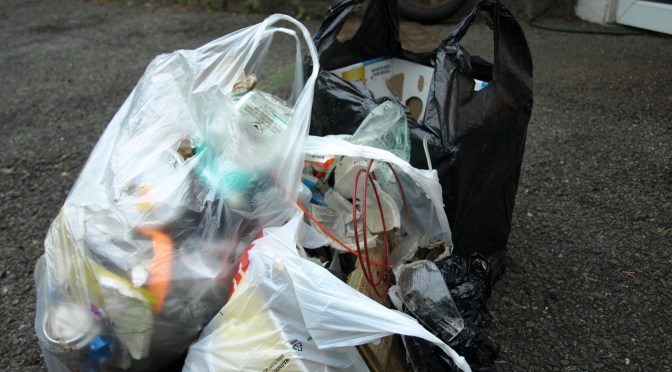
First of all, it was mind boggling just how much litter there was in this upscale Westchester suburbian neighborhood. A 30 min walk, covering maybe 1.5 miles produced 3 large bulging shopping bags of trash. From cans, bottles, cigarette boxes, milk cartons, yogurt containers to multitudes of single serve snack bags.

I was flabbergasted by the sheer number of carefully knotted newspaper sleeves with dog poop in it, draped decoratively on the curb, over someones fence or plainly thrown onto the storm sewer drain. What kind of person goes through the process of picking up after his/her dog and then believes to do the right thing by just dumping the bag somewhere?

The amount of litter in the storm drains is a stark reminder that people plainly do not know that the storm sewer goes directly to the ocean without any filtering step. Whatever washes into them will end up on the local beach as wash up. A sobering thought when going bag to the doggie poop bags.

The result of my social experiment was that every single car occupant that passed us turned their head to check out what we were doing and some rolled down their window to thank us. I believe, that the mere fact that they saw us picking up litter may have inspired others.

Being a role model pays off and it is really not hard to do!