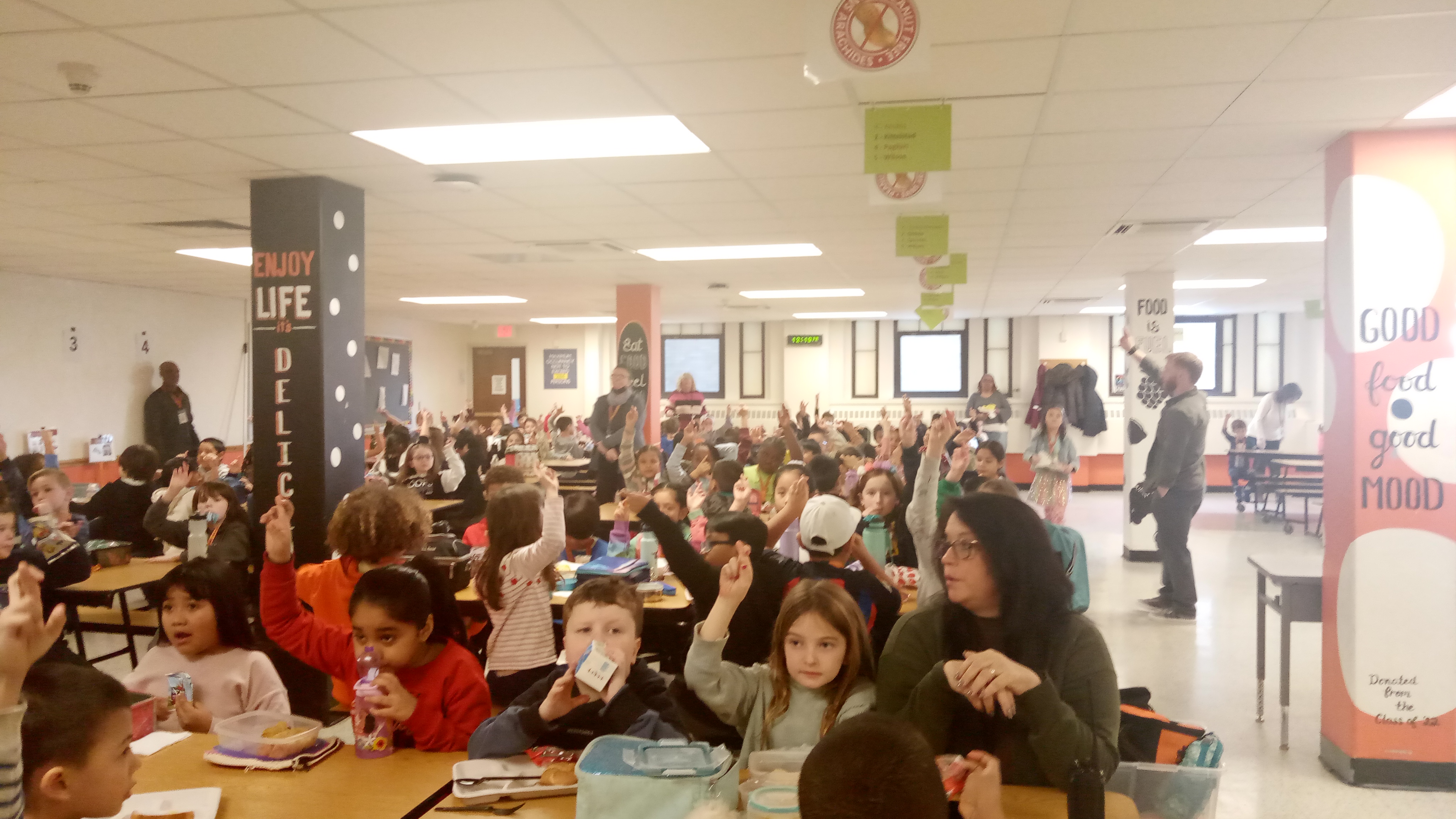
If you have ever been in a school lunchroom, unless you are faint hearted, it is a truly invigorating experience. 150 kids in a room, chatting, walking, playing, eating …. a never ending hum of activity. To control such masses, there are elaborate systems in place. Voice levels are measured and given a number code and students learn very quickly how a level 1 voice is being quiet. Students are asked to raise their hands if they need anything during lunch, and there are large posters with hand signals displayed for the kids to review.
Recycling is so normal for White Plains students that there is a hand signal established for it and it is working well. We Future Cycle is very proud to have been able to create a generation of White Plains students that care.
We recently launched the WeFutureCycle recycling program in the Ben Turner Elementary school in Mount Vernon. This school has so impressed me with its outstanding lunchroom monitors.
Part of the recycling program is also to teach the kids to only take what they need, which means to not grab a stack of napkins at a time, or a whole handful of ketchup pouches.
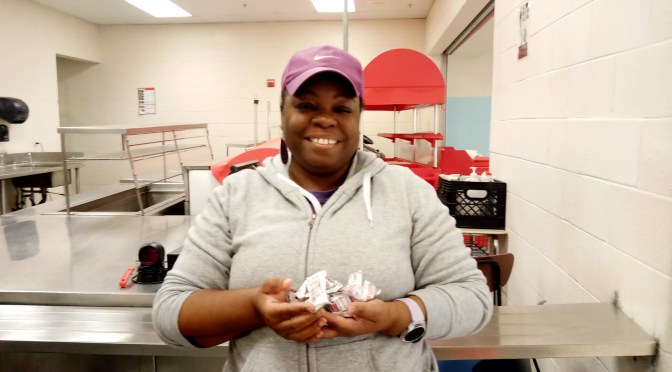
Making the right choices is a life lesson and lunch monitor Shantale Hughes is reinforcing that with her (very cute) charges. After her students have gotten their lunch, she helps them open their milk or other things and when she notices them having grabbed more pouches than needed, she collects them, so they do not become untouched garbage.
It takes a village to raise a child and Ms Hughes is clearly a very important part of the Ben Turner village. Thank you for going the extra mile.
Meet Crystal Beattie, a food service lead in a Westchester school district for the past 9 years. She makes cooking for 500 students look easy and she is one of the few schools that offers hot breakfast like those yummy sausage egg and cheese sandwiches in the cafeteria.
While offering breakfast in the lunchroom may have logistical challenges to fit all students into a relatively narrow time window, it comes with the great advantage of being able to offer a hot breakfast menu and also keeping all food and waste in the lunchroom, rather than in the individual classrooms.
Most school districts participate in the National School Lunch Program, established in 1946 under President Truman. This program helps public schools to provide low cost or free lunches to students. About 7.1 million children participated in the NSLP in its first year. Since then, the program has reached millions of children nationwide: 1970: 22.4 million children; 1980: 26.6 million children; 1990: 21.1 million children; 2000: 27.3 million children; 2010: 31.8 million children; and 2016: 30.4 million children.
During the pandemic all schools became eligible for free breakfast and free lunch and meals were then served in the individual classrooms to limit student contacts.
That meant for Food Service providers to heavily rely on commercially available, individually wrapped food items with long shelf life. And that means of course mountains of packaging garbage and food scraps in each of those classrooms. And milk spills in the classrooms, and food scraps on the floor, and an extra garbage run through every classroom by the custodial staff, replacing plastic bags in each classroom….
Can you just see the amount of labor, materials and garbage attached to this issue?
A typical breakfast in the classroom consists of a plastic bag that contains a plastic wrapped starch (bagel, muffin, granola bar or cereal) , fruit juice or milk carton and sometimes a jogurt. Food service staff will fill these items into bags, then knot them, then place them into individual tubs that will be brought up to each classroom. Students usually grab a bag, or open one on the spot to just remove the one item they want to eat and all the rest will go either in the garbage in the classroom, or will make its way down to the kitchen to be discarded there into the garbage.
The untouched food waste is just staggering, here is an example of returned breakfast items on one day from a school with 500 students.
Bringing breakfast back into the lunchroom has many advantages
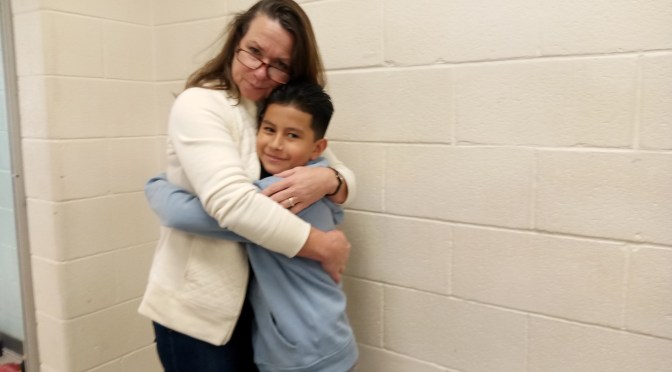
” Thank you for teaching us about saving the world”.
This heartwarming sentence, accompanied by a hug came from a 5th grade boy in the Ben Turner Elementary school in Mount Vernon.
This week we rolled out the WeFutureCycle recycling program at this school and taught the students in grade by grade presentation about where the garbage goes and how simple, small changes can make such a difference. Students learned about how garbage from the street makes it into the ocean. An audible collective groan went through students seeing how plastics enter the food chain and ultimately kill animals.
Teaching students that their actions can make a difference, little tiny changes of daily routines add up for positive change. It was heart warming to be hugged by these youngsters for teaching them that they have the power to make change.
This is what lunch waste of 800 kids can look like, after students learned to sort their waste into recycling, compost and trash.
4 lbs, in a quarter bag instead of the regular 80-100 lbs in 9 bags. A 97% reduction in waste.
Recently, 800 of Mount Vernon’s brightest at the Steam Academy high school learned about how personal choices and small changes can make a big difference. Learning where the garbage actually goes when we are casually throwing it “away” made them realize that we all have -quite literally- skin in the game.
Westchester’s garbage gets burnt in Peekskill, all 2500 tons of it, every day at quite nauseating expense to the tax payer.
And over and over, once garbage is actually sorted, we realize that a whopping 95-97% of that material is actually resource for other packaging if it had just been put into the correct bin, instead of trashing it.
The Steam students, after just one week, are now automatically separating their waste and thus help to divert resources out of the waste stream into recycling.
Every school can do this, as a matter of fact, we as society have the moral and self preserving obligation to teach in our schools that together the most pressing problems can be reduced by 97% if we just taught and reinforced solutions.
Most solutions are actually quite simple, just a change of attitude and a different hand movement.
The Steam Academy in Mount Vernon recently started the WeFutureCycle recycling program in the lunchroom, teaching students that just by sorting their waste into recycling, compost and trash can reduce garbage by 90+%.
In the lunchroom, the students are somewhat supervised and thus behavior can be modified, guided and enforced. After just one week, most students sort in the lunchroom easily and automatically.
The trick is to see if this behavior translate to other places in their lives without being supervised or encourage and I was very happy to see the hallway recycling stations in that building this morning.
We Future Cycle just rolled out the comprehensive recycling program at the Mount Vernon Steam Academy, a 9-12 HighSchool with a population of 800 students, all future engineers, doctors and astronauts. As preparation for the student roll out, we presented the advantages to the adults including security, food service and custodial staff.
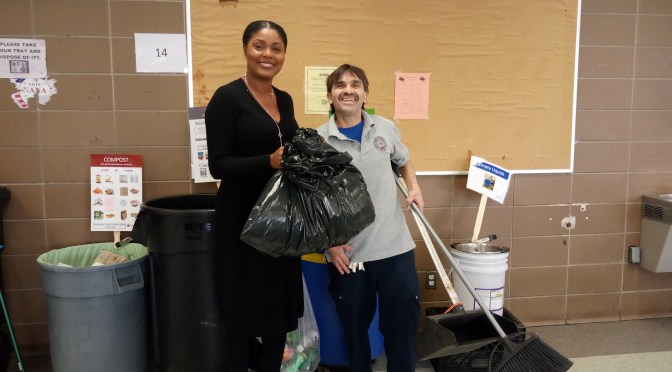
Because it takes a village to raise a child.
Meet Ivey Reid, the exceptional food service lead for the past 11 years. Ms Reid took to the program like a fish to water and decided on day one that she can go the extra mile in her kitchen in terms of waste diversion. Normally, the kitchen will sort out commingled and compostable materials, but this most fabulous lead also started to sort out clean clear soft plastic that would be recycled as plastic film at grocery stores, the resource needed for Trex decking materials.
And she made it look easy. A clear bag tied to the corner of a shelf, a quick explanation to her entire staff and off they went, and the result is a diversion rate of 97% in the kitchen, including a large bulging bag of clear cling plastic that otherwise would have been trashed and ultimately burnt into the air we breathe. Way to go!
How does one change the world? Easy, by changing the minds of people. And how does one change the mind of someone? By showing them that small personal actions can have a huge positive ripple effect through the community.
WeFutureCycle’s mission statement is “Creating a generation of kids who care” and we believe that if we teach students in schools that their small actions matter, we can change the world, one school at a time.
Every day participating students are sorting their waste carefully into recycling, compost and trash, thus diverting 90+% out of the garbage stream.
Think about that….90+% of a problem solved by a quick hand movement.
And the ripple effect through the community is that these kids bring these behavioral changes home and are starting to change the world, one household at a time.
I can tell you, life is not boring when you mix 6 y old kids with a bin of worms.
We Future Cycle presenters came to Mount Vernon Holmes Elementary School and while the older grades took their state tests, the younger grades had a chance to learn about worms. With big eyes, first and second graders learned how every living being on earth has an important job to do. Giggling, the students followed explanations that worms have no eyes and ears, and that they eat what ever organics are falling in their path and that their castings are good soil. Slight shuddering went through the kids at this thought.
Students are learning that worms -as all living beings- also need to eat, breathe, reproduce and die. Audible gasps came as response to the fact that worms have no nose and are breathing through their skin. All students rubbed their skin, clearly not quite processing how that could possibly work. While talking about how they move and how fabulous their muscles are, students got a chance to flex their biceps, as activity about muscle function and they mimicked the stretching and pulling motion of the worm. Can you imagine 23 wiggling children on a carpet?
When it came time to get down and dirty, the worms did not disappoint and samples on moist paper towels were oozing with worms of all sizes. Even cocoons were plentiful and easy to spot, to the utter delight of all children.
However, what took the prize and made this class indelible in student and teachers mind was that we got to follow the path of a “casting” from within the worm to outside. Worms are somewhat translucent and one can make out the dark spots in the tail section where the castings (technical term for worm poop) are making their way through the length of the worm. In laymen’s terms….we got to see a worm poop, and that was the highlight of the day, all kids clustered around that one poor shy worm to carefully inspect that freshly produced “casting”.
It was great fun and very heartwarming as students came to hug and thank us for teaching them.
Schools that are part of the National School Lunch program are walking a fine line between following guidelines that require students to take required food items and wasting food if the students are taking items that they are not intending to actually consume.
We Future Cycle’s mission in the lunchrooms is to teach students to sort their lunch waste into compost, recycling and trash. This simple change of behavior reduces garbage by over 90% and as by-product, it sheds light on just how much the students are being served that they do not consume.
Let’s step back to understand this problem better.
The National School Lunch Program (NSLP) is a federally assisted meal program operating in public and nonprofit private schools and residential child care institutions. It provides nutritionally balanced, low-cost or free lunches to children each school day. The program was established under the National School Lunch Act, signed by President Harry Truman in 1946.
Clear nutritional guidelines were established in 2012 under Michelle Obama’s guidance to make sure that commercial food service providers would not use the cheapest of all ingredients to feed the nations youngest for a quick buck.
These guidelines come with certain amounts of grain, protein, fruit, veggies and milk.
As students are sorting their lunch leftovers, we are also capturing the untouched, commercially wrapped food items to repurpose them, rather then just dumping them. COVID did not make this problem any easier.
This is the untouched food waste of ONE breakfast in ONE school. It is shocking and WeFutureCycle is working with the schools to find avenues to repurpose and donate these items back into the community as well as changing the menu to foster food acceptance.






 We Future Cycle