How does one change the world? Easy, by changing the minds of people. And how does one change the mind of someone? By showing them that small personal actions can have a huge positive ripple effect through the community.
WeFutureCycle’s mission statement is “Creating a generation of kids who care” and we believe that if we teach students in schools that their small actions matter, we can change the world, one school at a time.
Every day participating students are sorting their waste carefully into recycling, compost and trash, thus diverting 90+% out of the garbage stream.
Think about that….90+% of a problem solved by a quick hand movement.
And the ripple effect through the community is that these kids bring these behavioral changes home and are starting to change the world, one household at a time.
I can tell you, life is not boring when you mix 6 y old kids with a bin of worms.
We Future Cycle presenters came to Mount Vernon Holmes Elementary School and while the older grades took their state tests, the younger grades had a chance to learn about worms. With big eyes, first and second graders learned how every living being on earth has an important job to do. Giggling, the students followed explanations that worms have no eyes and ears, and that they eat what ever organics are falling in their path and that their castings are good soil. Slight shuddering went through the kids at this thought.
Students are learning that worms -as all living beings- also need to eat, breathe, reproduce and die. Audible gasps came as response to the fact that worms have no nose and are breathing through their skin. All students rubbed their skin, clearly not quite processing how that could possibly work. While talking about how they move and how fabulous their muscles are, students got a chance to flex their biceps, as activity about muscle function and they mimicked the stretching and pulling motion of the worm. Can you imagine 23 wiggling children on a carpet?
When it came time to get down and dirty, the worms did not disappoint and samples on moist paper towels were oozing with worms of all sizes. Even cocoons were plentiful and easy to spot, to the utter delight of all children.
However, what took the prize and made this class indelible in student and teachers mind was that we got to follow the path of a “casting” from within the worm to outside. Worms are somewhat translucent and one can make out the dark spots in the tail section where the castings (technical term for worm poop) are making their way through the length of the worm. In laymen’s terms….we got to see a worm poop, and that was the highlight of the day, all kids clustered around that one poor shy worm to carefully inspect that freshly produced “casting”.
It was great fun and very heartwarming as students came to hug and thank us for teaching them.
Schools that are part of the National School Lunch program are walking a fine line between following guidelines that require students to take required food items and wasting food if the students are taking items that they are not intending to actually consume.
We Future Cycle’s mission in the lunchrooms is to teach students to sort their lunch waste into compost, recycling and trash. This simple change of behavior reduces garbage by over 90% and as by-product, it sheds light on just how much the students are being served that they do not consume.
Let’s step back to understand this problem better.
The National School Lunch Program (NSLP) is a federally assisted meal program operating in public and nonprofit private schools and residential child care institutions. It provides nutritionally balanced, low-cost or free lunches to children each school day. The program was established under the National School Lunch Act, signed by President Harry Truman in 1946.
Clear nutritional guidelines were established in 2012 under Michelle Obama’s guidance to make sure that commercial food service providers would not use the cheapest of all ingredients to feed the nations youngest for a quick buck.
These guidelines come with certain amounts of grain, protein, fruit, veggies and milk.
As students are sorting their lunch leftovers, we are also capturing the untouched, commercially wrapped food items to repurpose them, rather then just dumping them. COVID did not make this problem any easier.
This is the untouched food waste of ONE breakfast in ONE school. It is shocking and WeFutureCycle is working with the schools to find avenues to repurpose and donate these items back into the community as well as changing the menu to foster food acceptance.
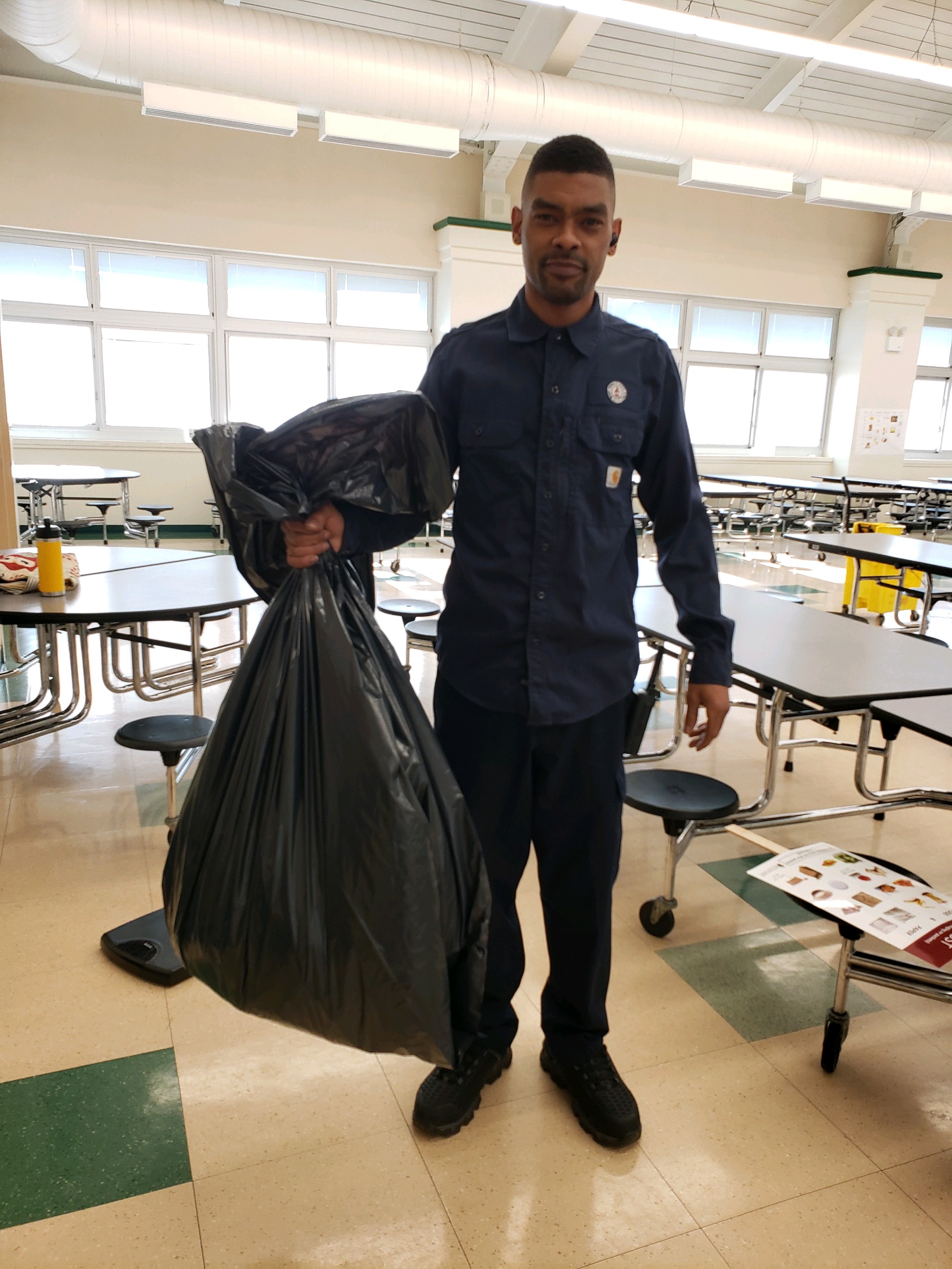
Students in grades K through 8 at Mt Vernon’s Hamilton Elementary School are learning that they have an important role to play in saving our Earth, with the help of custodian Craig and his team, plus lunch monitors and kitchen staff.
Before now, the trash bin was the only one in use in the lunchroom. Orange peels, plastic sporks, and napkins joined chip bags and straws in the trash, and about 100 lbs a day was carted to the Peekskill incinerator where it would be burned, creating endless smoke and pollution. Of this 100lbs,
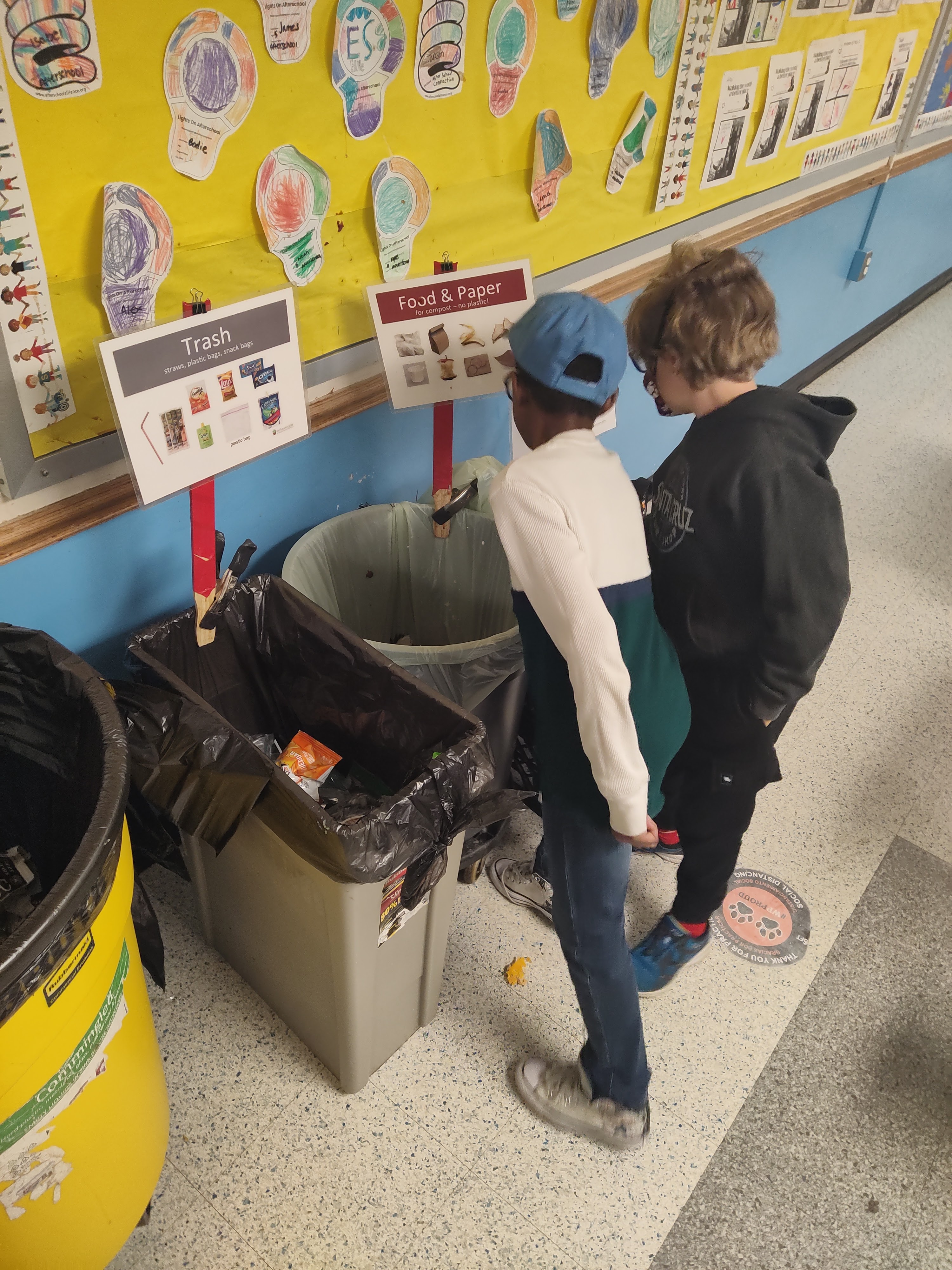
Now, children choose where to put their waste and leftovers. Through the simple act of sorting, students on launch day were able to keep 93.5% of their waste and leftovers from going to the incinerator (about 42.5 lbs were compostables, 12 lbs recyclables, and 29 lbs liquids). Instead, plastic containers are recycled. Dirty napkins are composted. Liquids are sent to the wastewater treatment facility to be cleaned until they can be part of the water cycle again.
The students know that because of their individual actions, our Earth will be a little bit cleaner, and that together, we can make a huge difference.
When a recent New York Times article (https://www.nytimes.com/2023/01/01/headway/composting-food-leftovers.html) described efforts in Ohio to reduce food waste, staff at WeFutureCycle Inc (501c3) smiled in recognition. The work the Solid Waste Authority of Central Ohio (SWACO) is doing sounds important and very familiar! Yes, Americans throw away 80 billion pounds of food every year. Yes, it does create untenable amounts of methane when sent to landfills, or horrible smoke pollution when burned in an incinerator, AND takes up more space in US landfills than anything else! Yes, it can be put to much better use! And significantly, children, such as the ones highlighted in the article, can make enormous differences to the amount of food wasted in their communities.
Students in the White Plains City School District work every day to keep food waste out of the incinerator (Westchester County trash is burned in Peekskill). School staff, including lunch monitors and custodians, as well as We Future Cycle representatives, train & assist each child to sort their lunch waste & leftovers into different bins for each material, including food & paper for compost. Schools that sort are able to divert between 90 and 98% of their waste AWAY from the incinerator! Much of this waste is food, napkins & compostable trays. These items are sent to Ulster County for composting, and in 90 days, instead of pizza crusts, uneaten apple slices, and dirty napkins, we have rich, healthy soil that can be used to grow new things. Additionally, burning less at the incinerator means less pollution from the smoke. While in 2018 the EPA estimates that about 4.1% of wasted food was composted (2.6 million tons), in White Plains schools, almost 100% is composted.
Just like children at Horizon Elementary in Ohio, White Plains children are learning about their significant role in protecting our environment and reducing waste by recycling & composting, every school day, from Kindergarten through senior year. They’re developing habits that will serve them and their Earth throughout their lives. They’re even sharing what they know when they get home – one mom told us her daughter won’t let her buy (non-recyclable) juice pouches anymore, and they now opt for recyclable juice boxes instead. Another parent shared that her daughter is encouraging them to compost instead of putting food scraps in the trash.
By starting children young the hope is that these habits become ingrained. Community by community, school district by school district, groups like SWACO and We Future Cycle are creating a generation of children who are educated about recycling, who understand the impact one person can make, and most importantly, who CARE!
WeFutureCycle’s mission is to create a generation of kids that care.
Our program teaches students to think past the garbage pail. They learn that their small actions of sorting their waste makes a huge difference and every single day, participating schools maintain a diversion rate of 95%.
Students are now sorting more or less on auto-pilot and are transferring that behavior across other aspects of their lives. We see more reusable water bottles, more reusable containers and more and more even reusable spoons and straws.
Students have learned that making garbage is actually a decision and they are now choosing to NOT make garbage.
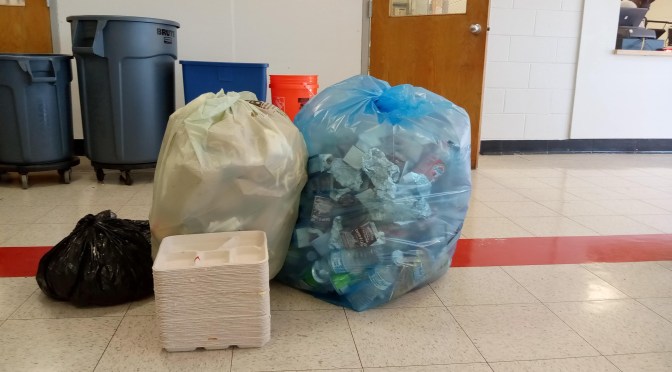
That was the subject of a recent series of presentation to Elmsford HS students. AHHS has implemented the WeFutureCycle recycling program in the fall and is maintaining a 94% diversion rate through recycling and composting. Students are now pretty much on auto pilot when they come up to the recycling station to quickly sort their left over into recycling, composting or trash. Every day, Elmsford HS produces one bulging bag of recyclables from the lunchroom and another one from the kitchen that go to the Westchester Material Recovery Facility in Yonkers .
Learning about the amount of trees felled every day for our daily paper, paper towels or milk cartons literally made them groan. Realizing where aluminum comes from they casually use to wrap their sandwich shocked them, and understanding that plastic in the environment can be a death sentence to all kinds of animals brought some of them actually to tears.
Civilization with its packaging takes a great toll on this planet. Elmsford students are learning every day that being the solution is as easy as changing a few hand movements and becoming conscious about oneself in the greater scheme of things.
Recently, We Future Cycle introduced its recycling program to the Carl Dixson Elementary School in Elmsford. This school houses Elmsford’s youngest, pre-K through 1st grade and it is now bustling with green activities.
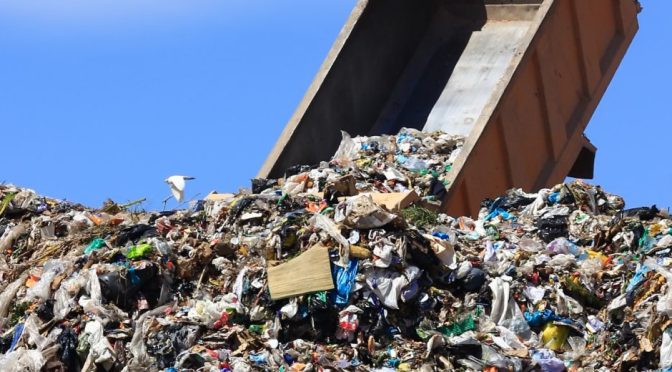
Students as young as 4 years old learned that their daily small actions can make a huge difference. They learned about what happens to the things they “throw away” They learned that there is no “away” on this Earth. The content of the garbage can goes somewhere and they were quite shocked to see what a landfill looks like and what an incinerator does to all of our air. All students agreed that we all have to take care of our Earth.
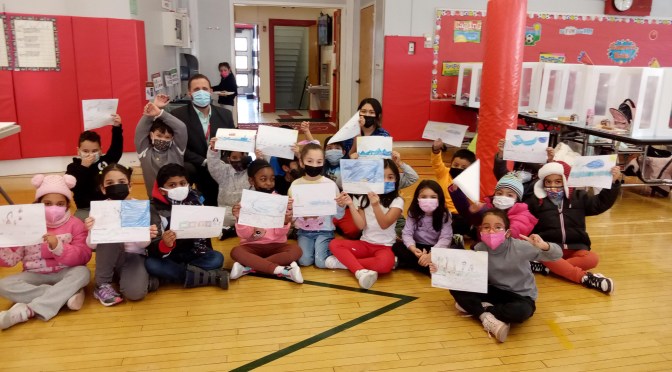
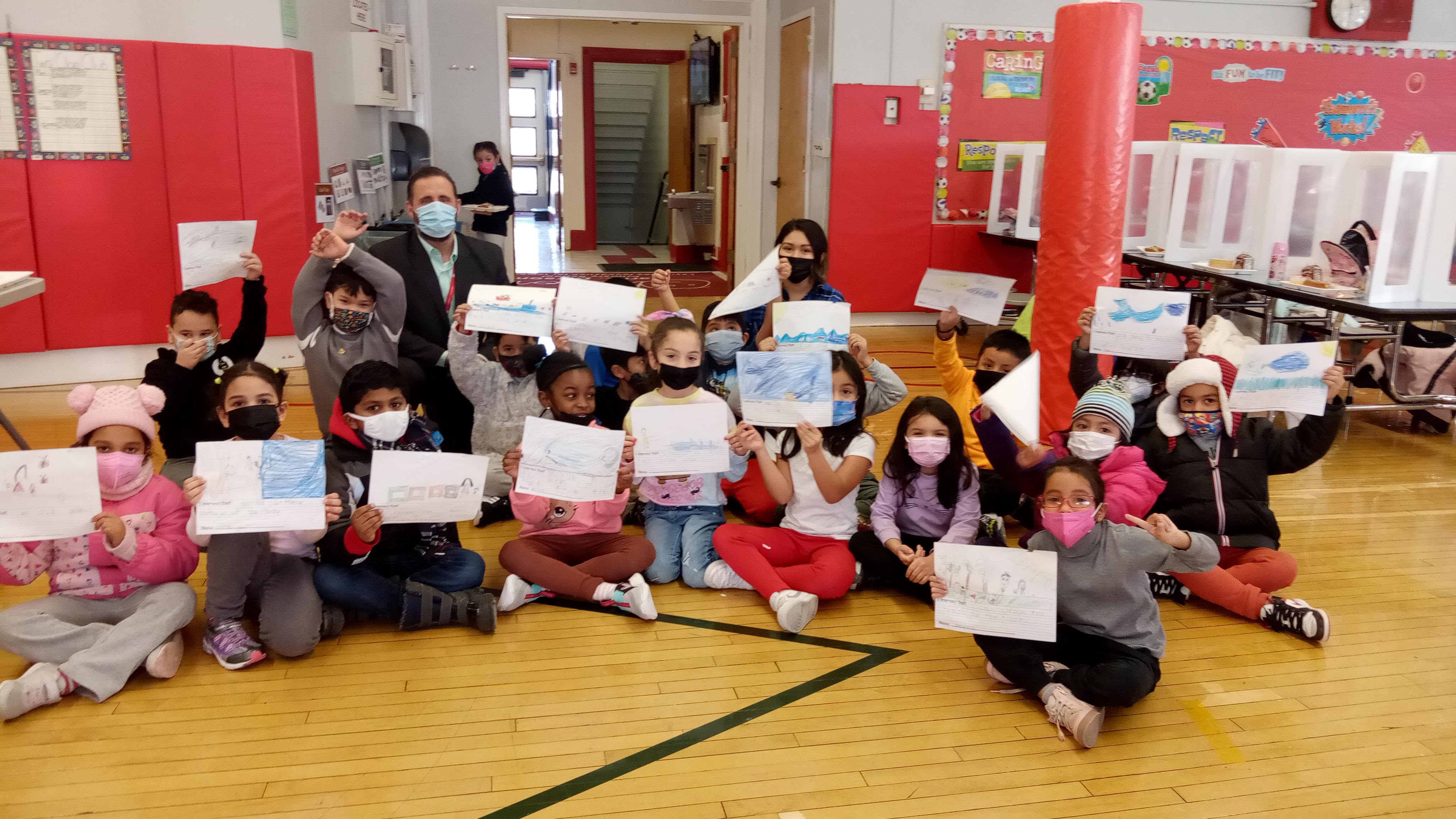
First graders wrote about what they learned and drew a picture about it. Here are some of the heartfelt examples
Samola learned that our garbage gets sent to Peekskill and burned and we breathe that air.
Nadia learned that litter kills animals.
Ivy learned that if you litter, the garbage goes into the ocean and hurts animals.
Loredana learned that we can make choices to keep our planet clean.
We Future Cycle’s mission is to create a generation of kids that care and we are so proud to show off the tangible results that hands-on environmental education can bring to schools.
Take a look at this lovely “Reusable water bottle parking area” outside the gym at the Church St school in White Plains.







 We Future Cycle