Tag Archives: recycling

White Plains School District Food Service, an Active Participant to Reduce Waste

OLYMPUS DIGITAL CAMERA
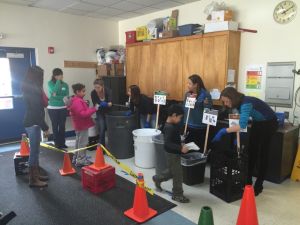
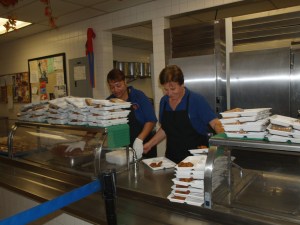
Church St Food Service workers preparing trays to keep  packaging at minimum

The success of source separating lunchrooms and teaching students about sustainable practices depends immensely on partnership with food service. The equation is easy, what goes in, must come back out. If food service sends many single serve packaging into the lunchroom, it makes sorting very difficult, potentially contaminating the food waste with plastic and ending up in the trash (or on the floor).

Have you ever tried peeling a sticky opened ketchup pouch off a tray? Not a pretty picture.

Ed Marra, Director of Food Service for the White Plains City School District, is a fabulous team player who took the We Future Cycle recycling program as chance to educate all his staff in sustainable practices. While only two of White Plains schools are piloting the program right now,  Mr Marra knew that all school employees can benefit from this kind of education.

He invited Anna Giordano to the Superintendents Training Day at White Plains High School to educate the staff not only about how the program works and what the children are learning, but going the extra mile to outline the environmental and social foot print each material has.
OLYMPUS DIGITAL CAMERA
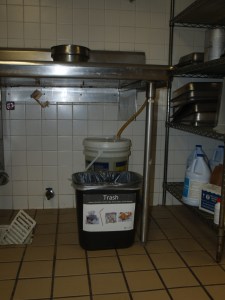
only 1/4 bin of trash per day

Cafeteria Manager Sadie Tatum shared that she had no idea that Aluminum foil comes from strip mining the rain forest and she has immediately stopped using aluminum foil in her cafeteria and her home.  Ms Tatum and her team excitedly set up their kitchen to follow the same sorting guidelines and all are stunned to see that at the end of a day, they had less then a quarter office size bin as trash. All food, packaging and soft plastic was sorted out to be composted and recycled, and the only trash was gloves and dirty soft plastics.

OLYMPUS DIGITAL CAMERA

“It is not hard, no big deal at all to sort”, Ms Tatum said when asked on how the system affected her normal day.

Mr. Marra actively supports the program by eliminating most single serve packaging, replacing them with squeeze bottles and dispensers. He also affected the change that bagel condiments were made “by choice” items and not just placed on the tray of the children, whether they wanted the creme cheese or not.

These kinds of  adjustments are often met with resistance. Arguments against replacing single serve ketchup pouches are that it is too much work to refill the squeeze bottles, or the students would take too much. However in White Plains, thanks to Mr Marra’s decisive leadership and the training,  the transition was flawless and it allowed Church St Elementary School to become a new Zero Waste Facility with less then 1.7% of trash, or only 3 lbs (!!!) of trash coming out of a lunchroom with 800 students.


White Plains Ridgeway Elementary School reduces garbage by 95%

White Plains Ridgeway Elementary school was chosen as one of the pilots to implement the We Future Cycle School lunch recycling program.

With enthusiastic support from Assistant Principal James Graziano  Ridgeway students learned  in assemblies that packaging is not trash but material for new things, they learned where the garbage goes when it is not sorted or recyclable, and they all agreed that they did not want to live next to a dump nor an incinerator. For good measures, they also agreed that animals probably won’t like living next to one either.

The custodial staff, under leadership of Pedro Molina, was super supportive, helping to set up the recycling station, going way out of their way to make the school a success. On Halloween a full bodied Batman was helping students at the recycling station. How fabulous is that!

Ridgeway had 124 lbs of waste of which only 6 lbs were actual trash, all other was either liquid, food waste, milk cartons or commingled recycling. A whopping 95% reduction. Now, that is truly something to write home about.

Ridgunnamed (5)eway’s parents came to “do lunch” with their children, helping to train the students in the new sorting system.  It takes active supervision and guidance to teach 700 students to sort and these parents were up to the task, fully supporting the efforts of the school to create a generation of kids that care.

Research: Longer Lunch Periods Mean Healthier Eating and Less Waste

According to a new study published in the Journal of the Academy of Nutrition and Dietetics, students with 20 minutes or fewer to eat at lunchtime rarely finish their meal and make unhealthier food choices.

While most elementary school children have about 30 minute lunch periods in the U.S., some spend much of their lunch period standing in line waiting to get their lunch.  We often see students come to the source separation station to recycle and compost leftovers with only a few bites of their lunch consumed.  When we ask why they didn’t eat more sometimes they say they didn’t like the food; however just as frequently they will say “I didn’t have time to eat everything.”

[Read the full article here]

This response confuses school administrators, as it would seem that 30 minutes is sufficient for a child to each lunch.  However, we have observed that students spend a lot of their lunch period talking, as it is often the first opportunity during the school day that they can relax and talk with their friends.  Socializing often takes priority to eating!

The research – and We Future Cycle – offer recommendations about how to reduce lunchroom waste and to encourage healthier eating.  Designing lunchrooms and lunch schedules to reduce wait times on lunch lines, and to offer as extensive lunch periods as possible, are constructive ideas.  While recycling and composting is great, the best way to reduce waste is to not create it!

New Rochelle’s Elementary Schools Recycle 2,000 lbs of Textiles In 3 Months.

New Rochelle’s Webster and Columbus Elementary Schools are extending their sustainability efforts beyond their successful lunchrooms. We Future Cycle introduced Textile Recycling through Spin Green as a fabulous fundraiser and both school principals eagerly embraced the initiative.

20090716_wastetoenergy_plant_33

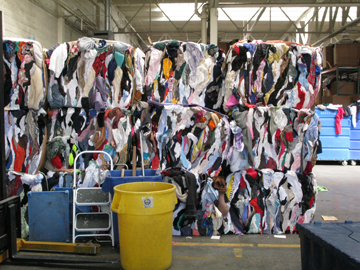
According to the EPA, Americans discard 13.1 million tons of textiles per year and there is only a 15% recycling rate. Many people give nice things as hand-me-downs away, but what to do with the stained T-shirt, the holed toddler jeans or –gasp– the underwear with the rip……?  Easy…recycle them in our Spin Green Textile Recycling Bin.

unnamed (7)We parents know how fast children grow and what clothes look like after a few months on an active child, but instead of discarding them into the trash, consider supporting the schools by donating them into their recycling bins. Any dirty sock, ripped sheet, old stuffed animal can go, anything that is clothy. Even shoes, sleeping bags, old blankets.

Once donated the textiles go one of these routes.

  1. The re-use avenue where usable clothes are sorted out and sold through second hand clothing stores or thrift shops.
  2.  The recycle avenue where the clothes are sorted according to material and then shredded down for its fiber to be used as rags or as stuffing for car seats and other applications.

goodwill_12smDiscarded textiles come with a huge price tag to society. They account for 4.9% of the municipal waste.

For Westchester, with its 2,000 tons/day garbage about 100 tons are discarded textiles EVERY DAY. At around $80 per ton tipping fee (which is just the cost to dump the load onto the incinerator floor, no transportation or labor cost are included yet, and of course no secondary cost such as road repair or environmental consideration), tax payers are footing an $8000.00 bill every day to make a resource -literally- disappear into thin air.

To learn more about the footprint of textiles here is a very interesting article.

The textile industry, according to the U.S. Energy Information Administration, is the 5th largest contributor to CO2 emissions in the United States, after primary metals, nonmetallic mineral products, petroleum and chemicals.

The textile industry is huge, and it is a huge producer of greenhouse gasses.  Today’s textile industry is one of the largest sources of greenhouse gasses (GHG’s) on Earth, due to its huge size. In 2008,  annual global textile production was estimated at  60 billion kilograms (KG) of fabric.  The estimated energy and water needed to produce that amount of fabric boggles the mind:

  • 1,074 billion kWh of electricity  or 132 million metric tons of coal and
  • between 6 – 9 trillion liters of water

Thanks to Melissa Passarelli and Sonia Nunez, students of Columbus and Webster are learning about the importance of recycling textiles.

Senator Latimer supports We Future Cycle Program implementation throughout NY

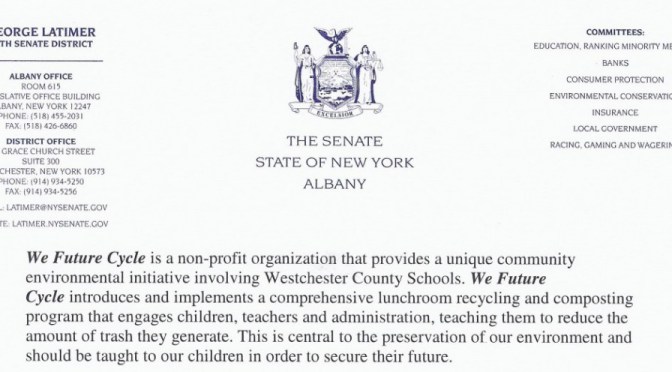
We Future Cycle is honored to have its lunchroom recycling program endorsed by Senator George Latimer. He took time from his busy schedule to visit a We Future Cycle Recycling implementation at BMP Ridge Street School in Rye Brook, NY, and he has also met with our team to discuss grant opportunities.

Thank you Senator Latimer for your public support.

latimer letter wfc

Update: Carton Recycling Integration Finally Planned for February 2016 in Westchester County

2_single_stream

Update:

Louis Vitrone just shared that the upgrade equipment is being purchased and a February 2016 start date is being envisioned. That is great news for  Westchester, as it will take an additional 1% of resources out of the waste stream and turn it into revenue for the County.

Original article from 2014:

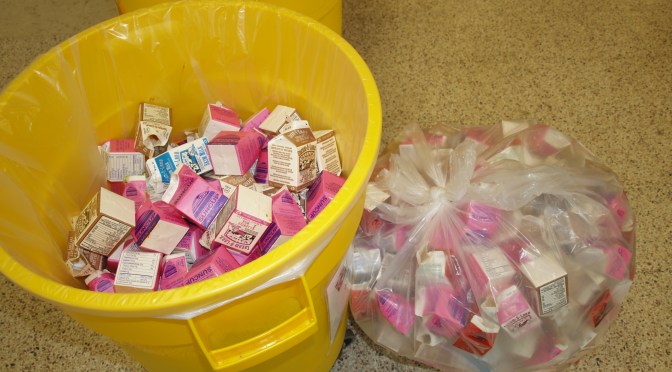
Milk cartons and juice boxes are a common sight in schools, and so far they are being trashed in Westchester County. In New York City, they are part of the Commingled recycling stream.

We have worked closely with Louis Vitrone, Deputy Commissioner  and Marianne Patronella, Director for Resource Management from Westchester County Environmental Service to bring carton recycling to Westchester. Just in November another meeting between the County and the Carton Council took place to find ways to make it work.

Part of the problem is that if a material is added to a recycling stream, it can really only be recycled if it is sorted. This sorting is done by a complicated sorting system which includes among other optical scanners to identify materials and then sort it via air stream into the correct container. The optical scanner itself is available and manageable in cost, but because Westchester’s Material Recovery Facility was one of the first built, its building doesn’t lend itself to easy equipment changes and the upgrading of the system is complicated and needs proper planning.  Yesterday’s meeting was a giant step in the right direction.

Schools that are using commercial carters such as Suburban Carting can already recycle their milk cartons as it is brought to a different facility that can sort out milk cartons.

Cartons are about 1% of Westchester’s waste stream and are a very valuable resource.

Here is a little educational youtube clip how easy it can be.

Cash For Columbus School Writing Competition Winners

OLYMPUS DIGITAL CAMERA

Columbus Elementary School was the proud winner for the coveted Nina Chin Writing Contest Grant. Mrs. Nunez, Principal, gave 3rd, 4th and 5th graders the opportunity to participate by writing an essay to the Topic “I can make a difference”. 145 students rose to the challenge, an outstanding level of participation, thanks to two teachers Ms Costa and Ms Alexander-Zahn, who went from class to class to promote the contest.

On June 15th at 10:00, the auditorium was filled with excited students. Who snagged the top prizes per grade?

OLYMPUS DIGITAL CAMERA

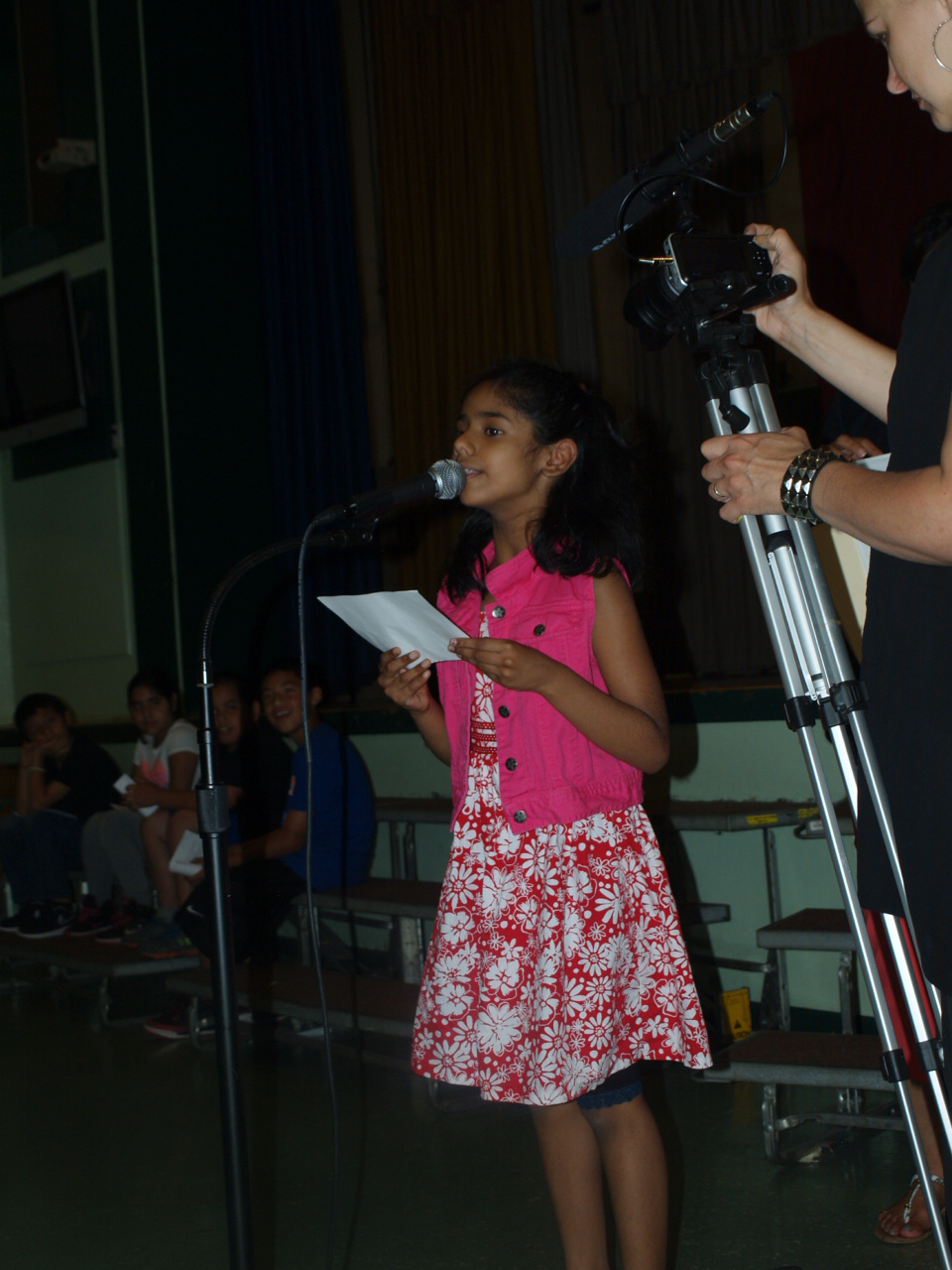
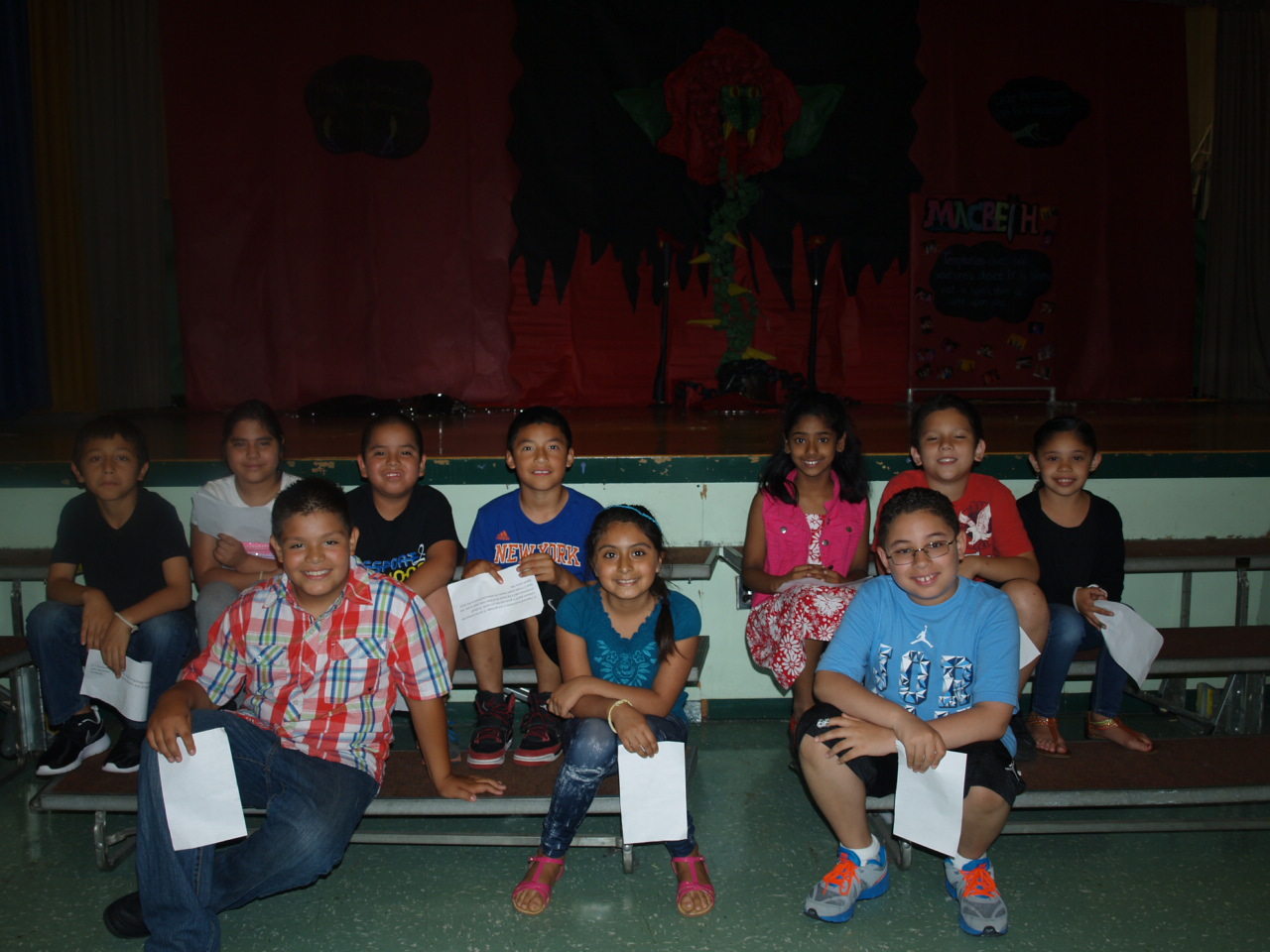
The ceremony began with a presentation by 11 students sharing information about Columbus’ recycling program. Students shared that they learned that they can make a big difference by sorting their waste into different categories, they were proud to have weighed the materials and realized that instead of making 400 lbs or garbage, they only made 8 lbs and all the rest is now raw material for new things.

OLYMPUS DIGITAL CAMERA

A second grader said that she is now the recycling specialist in her house and is teaching her mom about it. A kindergarten student  loudly proclaimed that we only have one Earth and she will make sure that all her friends are taking care of it with her.

OLYMPUS DIGITAL CAMERA

A sideways glance to the dignitaries Derrik and Jean Chin, Irene Schindler and Rev. Jennie Talley showed that they were very moved, clutching tissues.

OLYMPUS DIGITAL CAMERA
Sonia Nunez, Principal

The second part of the celebration was Mrs. Nunez calling one by one the runner ups and winners per grade up to the front to receive their certificate and their envelope with the cash prize. While the kids came up, some excerpts of their essay was shared.

Some truly powerful statements came from these young minds.

Mia Torres shared in her essay that she wants to help the environment because when she looks outside, she sees plastic bags in the trees. She doesn’t like that because the trees help us breathe.

Jasmin Alvarez very wisely said “Live like every day is Earthday!”

OLYMPUS DIGITAL CAMERA
Mia Torres, 3rd grade

And Willy Hidalgo says; ” to make Earth green we have to care for it. We also have to clean up liter and garbage, even if it is not yours!”

Willy, you are SO right! Well said.

Michelle Oliveros thought long term, an outstanding achievement for a 5th grader. She said; ” We have to keep the Earth clean for our future families. We also have to let our families know about recycling and reusing. It is all about our Earth.”

New Rochelle Columbus Parents Eagerly Helping Students To Learn About Sustainability

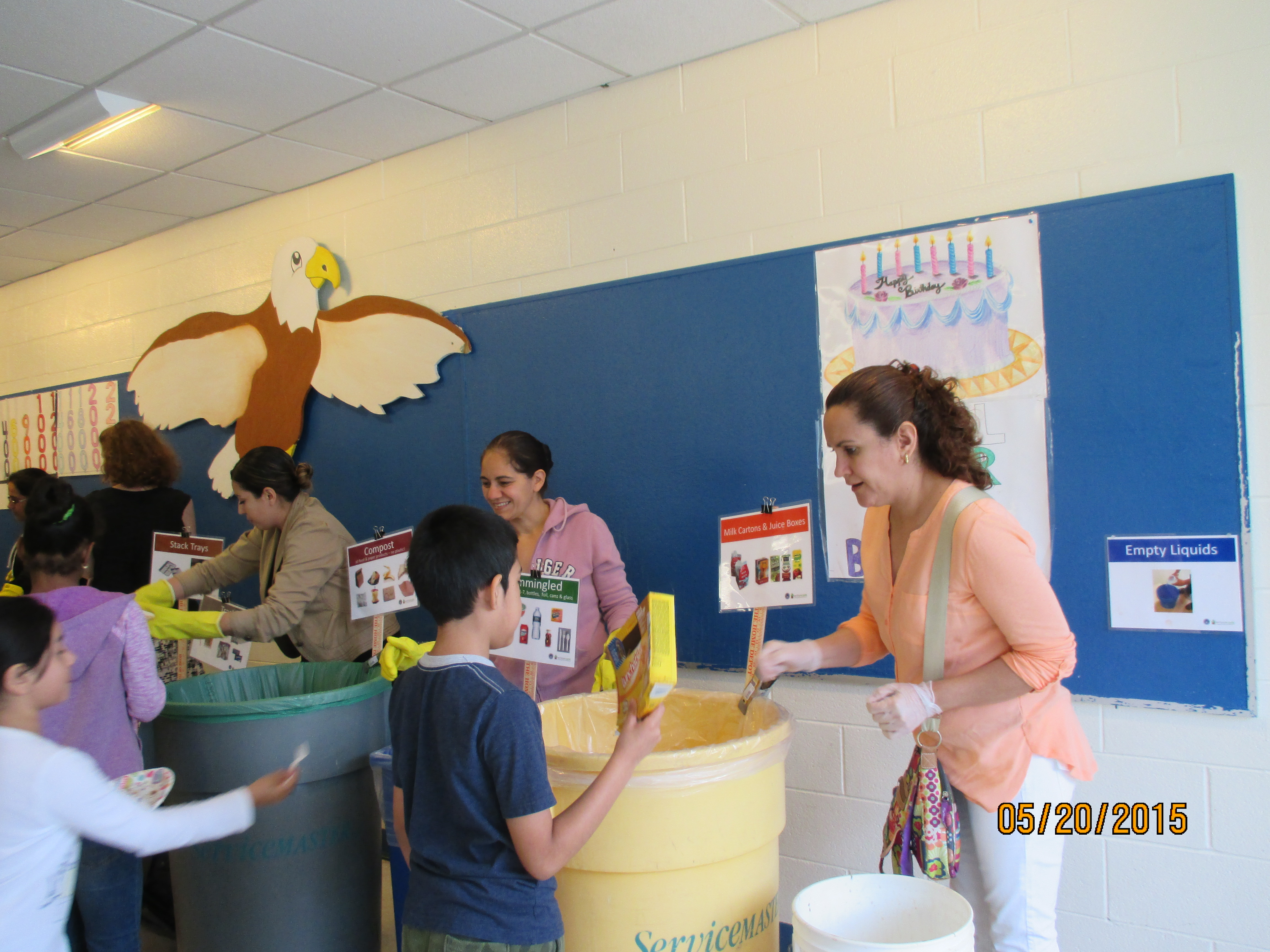
Columbus Elementary School has recently implemented the We Future Cycle School Lunch RIMG_0297ecycling program and under the leadership of incoming PTA President Karina Torres, many very  engaged parents at the Columbus Elementary School are stepping up to the plate….. or better, the  source separation station…to help teach students about Sustainability.

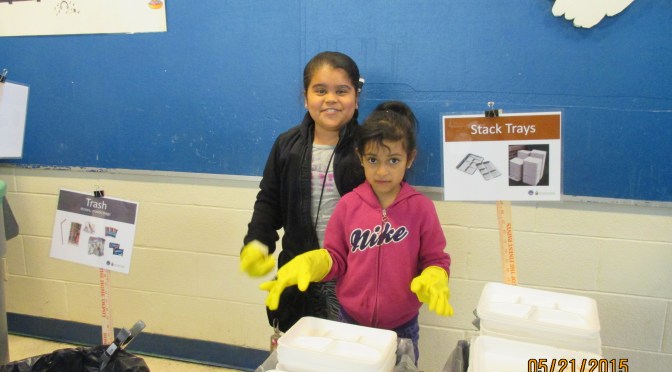
IMG_0322During each lunch period the stations are filled with exuberant students, donned with yellow reusable gloves, teaching others how to sort properly, under the watchful eyes of the parent helpers.

Karina Torres shared : “I am happy to see how the students ask me if I can ask their parents to come to school to help with the recycling project.”
Laura Flores commented with a smile : “I am impressed at the student helpers.  They are informative at directing their fellow schoolmates to show them where each recycling item goes, these children are our future recycle savvy.”
And the ultimate proof that environmental education in schools can change the community was shared by Maricela Jimenez: “I will now start to make changes to my everyday use of items…a simple change is to use reusable containers rather than ziploc bags which creates more trash”.

IMG_0284

Many parents commented that it was an interesting experience to see their children in the lunchroom environment and they really enjoyed being part of this project.  Some mothers expressed shock at the amount of food that is wasted. Every day, the students are sorting out untouched food items into a share basket. A typical lunch will generate 2-3 copy paper boxes of untouched food.

IMG_0292Araceli Perez: “I find it very interesting how all the students, staff, and parent volunteers work together to teach one another the methods of recycling. My daughter now teaches every one at home that there are other forms of recycling such as food waste is for compost.”

Ms. Owens, Assistant Principal, Anna Giordano and Maggie Dickensen (Whitson Food Service Manager) are working together to reduce the food the children are taking but not eating, as well as how to channel the untouched food to the local needy.

Ms. Nunez, Principal, is very proud of how Columbus School has embraced this program and rightfully so!

New Rochelle Columbus Students are making a huge difference

Introducing Sustainability Education and Source Separation to a school is a massive undertaking because of the sheer number of  stakeholders. Think about it, changing behavior from “throwing it all away” to “responsibly sorting” in a building that has 1,100 people zooming through it at all times is huge!

Well, New Rochelle’s Columbus Elementary School is showing how it is done.

Ms. Nunez, Principal, and Ms. Owens, Assistant Principal, know that it takes everybody to be on the same page to be successful – not just within the building, but also from Food Service, Facilities, Central Administration and of course the parents.  A brilliant move to create consensus and ownership of the program at every level.

We Future Cycle then presented to each stakeholder group, such as the custodial staff, teachers, parents, monitors, and every single student in small groups. Sharing the visual of the amount of garbage that is being generated every day, and then adding it up to just one week was greeted with audible sounds of shock and disbelief.

IMG_0258


23 bags of trash every day is a pretty powerful argument, and that is just from lunch. It does not even include the 20 bags coming out of night clean.

IMG_0288


We Future Cycle involved the students to help with a Waste Audit. The students counted every single packaging material that is brought into the cafeteria and the raw data is now with the 5th grade Kaleidoscope students to work with.  Learning how hard data collection can be was a lesson in itself.

Read here how Columbus students reduced their lunchroom waste by 98%.

Setting up a building to allow for proper flow of materials relies heavily on clear and consistent signage as well as proper placement of the correct bins. Head Custodian George directed his team to set up each bin as per our suggestion with the signage provided by us, and the success was instantaneous. Kindergarten students carefully rinsed out their snack containers to place them into the commingled bin, proudly informing the teacher. “See, I am recycling, Mr Mastro.’ Every day, eager hands are up to get the job to bring the class room bins into the central hall way stations.IMG_0321

Columbus is only a few days into the process, but has already successfully reduced lunchroom waste by 98%, from just under 400 lbs per lunch to only 8 lbs, and the building output has also drastically been reduced by diverting the paper and commingled into recycling.

Columbus students are super excited because a film crew is covering the transformation of the school and the documentary is going to be shown on the big screen.  I can share already with you that Columbus is full of raw talent. So, watch out for the showing of “Columbus Students are Making a Real Difference” coming soon to the picture house near you.

IMG_0303


How Much is Actually “a Ton of Garbage”?

Garbage costs money.  However only very few people actually know how much it costs and what a ton looks like. Very few of us think further then to the curb.

Let’s look at school garbage a little closer. A school with 830 students generated 23 large black bags of garbage every lunch, the total weight of those bags is 398.5 lbs.

This is what 23 bags look like. IMG_0258 Now that we know what about 400 lbs of garbage looks like, lets think about it.

A ton of garbage costs the tax payer around $80.00 to just dump it onto the tipping floor of the Incinerator, the big trash burning facility up in Peekskill. 400 lbs is a fifth of a ton.  So, imagine 5 times the amount you see, or 115 bags of trash. Clearly the $80 per ton does not represent the only cost of garbage. This material has to be put in bags, then brought outside into the dumpster, then loaded by workers into diesel fuel guzzling trucks (about 2.5 miles per gallon of diesel), driven to a transfer station, dumped there, then loaded onto large trucks and driven 50 miles up north to be dumped onto the tipping floor of the incinerator. And then it is burnt into our air. I get dizzy just looking at how often this material needs to be touched and handled for it “to go away”. It takes that much time and effort to “just throw something away”.

We just started the School lunch recycling program in this school and the kids sorted their lunchwaste into liquids, commingled, milk cartons, compost and trash. The results were astounding. unnamed

Out of the previous 398.5 lbs, only 8 lbs were actually non recyclable. That means that 98% of the material is recyclable.  So, “just throwing it away” is not just costing us a lot of money, but in fact, we use tax payer money to burn materials that we could easily sell for a profit. unnamed (2)

This is what 10 lbs of commingled looks like. Some math on the value of commingled. 1 ton of plastic PETE 1 sells from the Yonkers MRF for around $800. (the cost is market driven, oil dependent and is fluctuating). 10 lbs of plastic (to simplify this calculation, it is all the same resin) 2000 lbs of plastics sell for $800.00 10 lbs = $4.00 Milk cartons sell for $450 per ton. 30 lbs = $6.75 IMG_0278And this is what 15 lbs of milk cartons look like, we had two of these bags. And two full 5 gallon buckets with waste liquid weighing 74 lbs. That means we use fossil fuels to truck liquids 50 miles north just to burn them, rather then sending them down the drain? By far the heaviest was the food waste. 180 lbs of wasted food from 800 kids, plus about 50 lbs of untouched never opened food that was placed into the share basket. Clearly, a ton of garbage is a lot, but as you can see, only 2% of it is actually non recyclable.

So, our convenience to “just throw it away” costs us all dearly. Not just as hard cash but also at great environmental expense.