
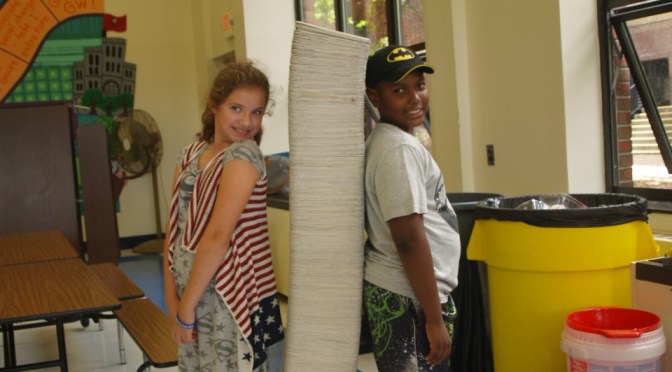
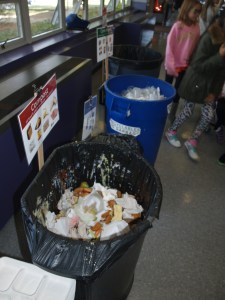
Check out that pile of sorted out trays! Today was the big roll out day of the We Future Cycle Recycling Program in the 4th Elementary School of White Plains. The waste audit yesterday revealed that GW with its 650 students generated normally 16 bags of trash, weighing 235 lbs. All students went through class by class presentation by experienced WFC staff that skillfully walked the children through the realization that just because a food packaging is empty, it does not mean it is garbage and thus useless. Students learned that most of their everyday lunchroom packaging is fully recyclable if just sorted out, and they also learned that by sorting out the food waste, we could create compost, a valuable resource.
Looking at pictures of the piles of garbage from their school, generated from lunch and night clean, and then learning that there is no “away” for garbage was eye opening even for the littlest one. When asked if they were ready to save the world by sorting their waste into the right bin, they were READY!
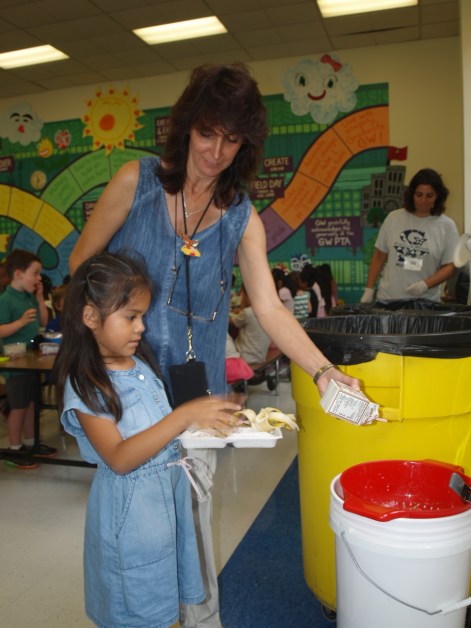
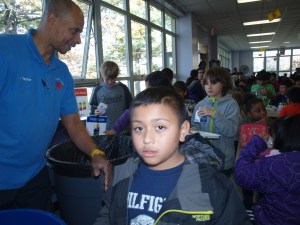
And they showed it in the lunchroom! Under wonderful guidance of the entire TA staff, and great personal engagement by the head custodian, the students, from K through 5 pulled off a wonderful job and reducing their garbage by a whopping 98% by sorting the materials into Food Waste for composting, Commingled for Recycling, Excess Liquid to go down the drain, and untouched food to be donated. From 291 lbs only 6.5 lbs were actually trash, one small fluffy bag, instead of the 16 heavy dripping and bulging bags from yesterday.
That is truly something to write home about. All of GW students can be proud that they are making a real difference every day now.
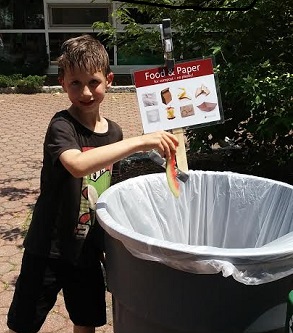


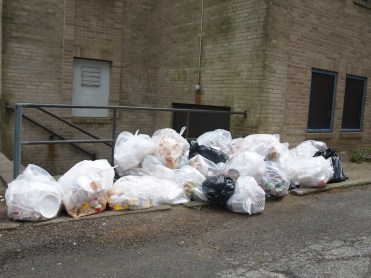 Diverting 98% of school lunchroom waste into recycling is now normal at the Westchester Schools that are running the We Future Cycle recycling program. This is what came out of a school with over 1000 students every day. 32 bags of loosely filled, dripping with left over milk.
 On April 23rd, just in time for Earth day, Westchester’s Material Recovery Facility added milk cartons to their list of recyclable materials. They are actually taking not only milk cartons which are called by the industry “gable tops” a paper product container with a PET lining, but also “aseptics” which is a paper container with an aluminum foil and PET liner.
 Students from K through 2nd Grade are carefully walking the blue classroom compost pail to the school courtyard that houses a lovely learning garden, a greenhouse with the first projects budding and a nice compost tumbler.






 We Future Cycle