
Check out this fantastic art work from recycled material decorating the hallways of New Rochelle Isaac Young Middle School.


Check out this fantastic art work from recycled material decorating the hallways of New Rochelle Isaac Young Middle School.

What happens to the food waste that New Rochelle students are sorting out in the lunchroom to be composted? How does composting work and is it really worth the effort? Those were questions that New Rochelle Trinity 5th graders are learning the answers to.
We Future Cycle, a not-for- profit organisation specialized in large scale sustainability programs has been working with Trinity Elementary school and its 1000+ students for years now. Source separation and words like commingled and compost are second nature to these kids.
In classroom presentations, students learned what happens to food that is put into a landfill, they learned about harmful Methane as potent green house gas and large contributor to global warming and they learned about the chemical processes that take place inside a compost pile. Giggles and audible gasps were heard when they learned that each one of them is a decomposer as the banana that might go into their mouth does not come out quite like a banana again.
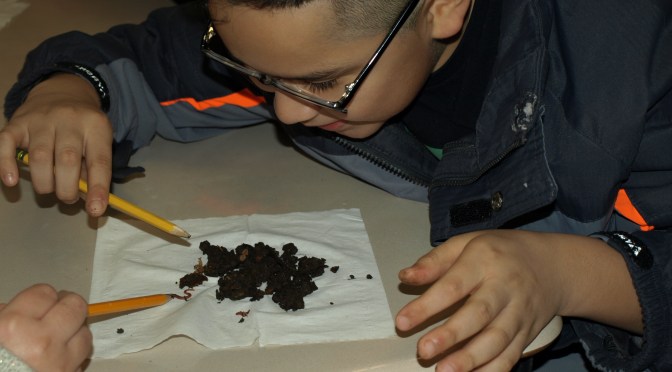
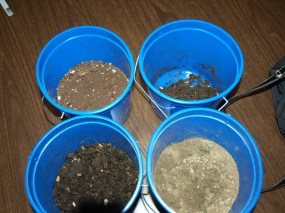 The best part was digging in the dirt as they got to examine up close and personal four different soil samples. Inspecting them while looking for color, texture, water retention capabilities and organic matter content gave them a deep understanding of the connection between healthy soils and its ability to grow food.
Each worm they found was greeted with cheers and great enthusiasm.
Trinity’s 5th graders have learned now that treating food waste as garbage is wasting a valuable resource. Making compost from food waste and leaves is making black gold, and it saves a lot of money.
For more information:
Why food composting can save Westchester’s taxpayer money, big time!
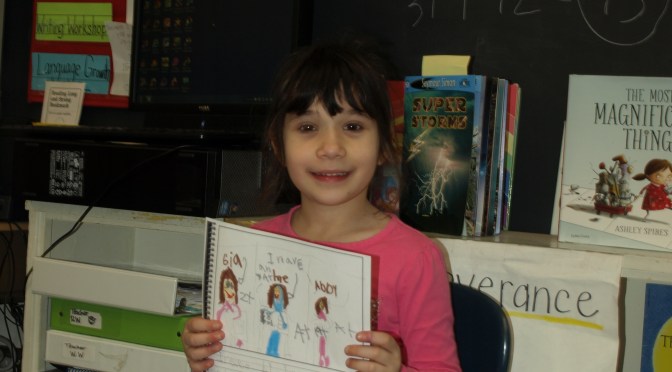
” I reuse by using a plastic container for lunch and a metal bottle” writes and illustrates Amanda Koffler.
We Future Cycle recently did a refresher class in all classrooms of New Rochelle Davis Elementary School. Students learned more about how bad garbage was for the environment, and that there is no “away” on this Earth.
Ms Curry’s First Grade class was all fired up and decided to write a book on how they will make a difference and help this Earth.
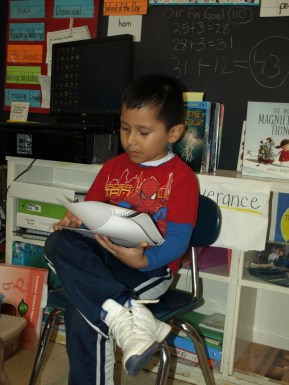
I was very impressed. Jefferson Rabanales wrote a “How to” story on sorting. He titled it “How to recycle” and outlined clearly the steps.
Nadia Morales very nicely color coded her picture and summarized : “I help the Earth because I recycling”
Abigayle Mills outlines that she helps the Earth by always bringing reusable water bottles.
Nalani Canales re-purposes materials to make new things out of it. “I help the Earth because I reuse a shoebox to make a mailbox”
Juliana Rubino has the right idea. “I clean up the Earth because I clean up the Earth every day”
Every single one of Ms Curry’s students pledged to help the Earth. Way to go!
New Rochelle School District is now running the We Future Cycle Recycling Program in all of its elementary schools and one of its middle schools, close to 7000 students are sorting their waste every day, instead of just dumping it all into the garbage.
Every single school has reduced its waste by 95 to 98%, from 20 bags down to one. From 350 lbs down to 7.5 lbs. Part of the program is the sorting out of the untouched food. The food the students take but end up not consuming. And there is LOTS of it.
The We Future Cycle Recycling Program is working this problem from both ends. One side is to reduce through education the amount the students take without intention to consume it, and the other side is to sort it into a donation basket rather then dumping it.
Isaac Young MS students just started the program and through sorting, rescued 2 crates of untouched food every day. This food is going to HOPE Kitchens, a non-for-profit soup kitchen that feeds needy New Rochelle community members. A win-win situation.
Any parent of a middle schooler can attest to the level of difficulty of making their youngster do anything out of the ordinary, especially if it does not involve electronics.
New Rochelle Isaac Young MS just joined the growing group of schools to have introduced the We Future Cycle Recycling Program. This program reduces waste by sorting materials into excess liquid, recyclable material, compost and untouched food to be donated. Isaac Young MS results were particularly astounding.
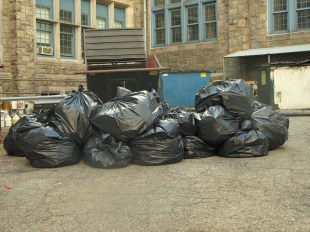
From 348 lbs down to a mere 7.5 lbs, from 20 bulging and dripping bags to one single fluffy one.
Under the guidance of Assistant Principal Dan Gonzales and Head Custodian Bill Coleman, the school systematically put the program in place. The We Future Cycle Executive Director presented to all teachers, all security staff, all custodial and night clean staff and finally to all the students the detrimental effects of garbage on our environment and how easy it is to sort the waste into recyclable and compostable avenues.

Teachers reported how shocked they were to learn about the cost of garbage removal to the tax payer and to society at large. Students reported that they had no idea that something as easy as sorting could make such a huge difference.
All of Isaac Young 6th graders had gone through the program already in their elementary schools and fell right back into the routine. 7th and 8th graders are adjusting nicely to the “new normal”. Both lunchroom cleaners as well as the head custodian are reporting that they were skeptical in the beginning but upon seeing the amazing results are fully on board.
We Future Cycle is excited to be also part of the newly created Recycling Club to bring even more environmental awareness to the students. Plans are in place to use the lunchroom walls for student made educational materials outlining the environmental foot print and end of life cycle challenges of packaging materials they hold in their hand on a daily basis.
Recycling at a Middle School, not for the faint hearted but New Rochelle Isaac Young MS pulled it off flawlessly. Way to go!

Getting down to grab a misplaced yogurt cup out of the compost bin is not for the faint hearted, but it is essential for the success of the We Future Cycle recycling program.
This program teaches students to sort their lunchroom waste into excess liquids, recyclables, compostables and untouched food. And low and behold, only 2-5% of the initial amount is actually trash.
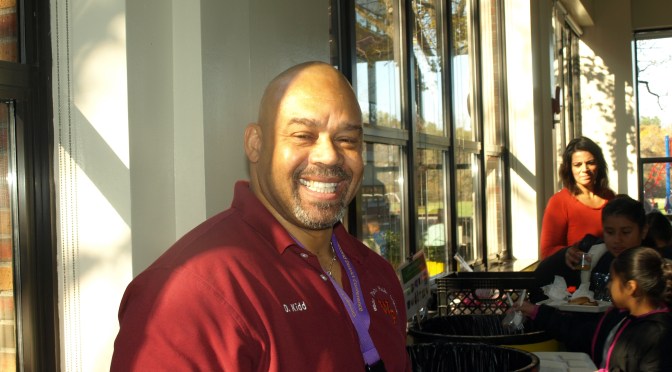
White Plains George Washington Elementary School Head Custodian Darrel Kidd supports the program 100%. He says, it makes his life much easier because now, he does not have to bring a single bag of garbage out until the very end of lunch, when he cleans up the station. And then he casually slings the 6 lbs bag over his pinky finger. Because 6 lbs of trash is all that comes out of the school of 630 students. Down from 235 lbs, a 98% reduction.
Biggest challenges in each school is crowd control so that the kids are not falling over each other while recycling at the station. Mr Kidd is the master of untangling traffic jams at the station, he supervises that nothing but food and paper goes into the compost bin all the while keeping the kids in the flow.
Ownership of the program within the school is the key to success and the custodial staff of White Plains GW school is owning this program for good! Way to go.
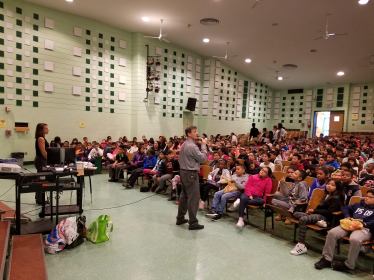
As a sustainability consultants to the largest school districts in Westchester County, We Future Cycle presenters get to talk to many students, personally my favorite part of the job.
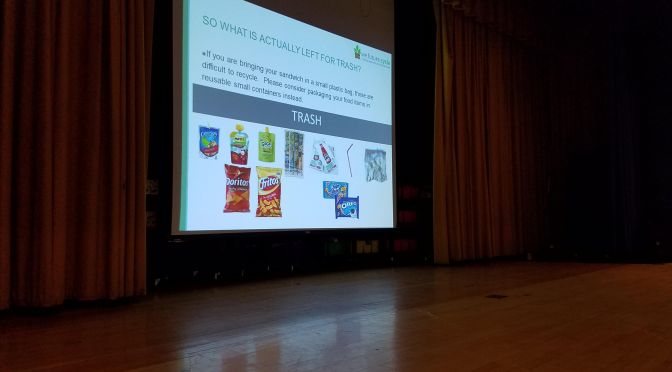
I usually bring a full bag of all kinds of packaging material which I theatrically empty onto a table in front of the students and then neatly arrange the empty bottles, empty cups, empty wrappers, empty boxes, empty bags, empty juice pouches. I remain quiet while listening to the students wondering aloud what I was doing with all that garbage. Some positively snare at it.
I then ask the students what I brought them, holding up a random empty packaging item. A kindergarten student would tell me exactly what I held in my hand…a bottle, ….a can…. a fork. By 2nd grade latest, I get disgusted shout outs of “garbage!”, or “trash”…..with the occasional “recycling” thrown in.
I start by telling them that I did not bring them trash. I pause. They are quiet and bewildered. Then I tell them that I did not bring them recycling. Again I pause. By now, the students are clearly confused, but their interest is very much peaked, there is no sound to be heard, they are anxiously awaiting my answer. And then I tell them, that I brought them material and they decide every time they discard something if it becomes recycling or trash, just by choosing the right bin. Walking them through the example of building with lego brings the concept “many small pieces make something usable, which can be broken down again into small pieces” very much home to them. They got that. When I asked them if they would ever consider throwing their lego in the garbage, they emphatically call out “no” and when I ask them if they ever considered throwing their left over sandwich into the lego box, they paused for a split second and also called out “no”, but in that split second, they got it. They got that everything has its place and mixing it is no good.
Teaching them from here on was a breeze. At the end, when I asked them if they are going to make good choices now as to where they put their material, I got an enthusiastic positive response. New Rochelle Columbus students are pledging to make every time they have to discard something the right choice! Way to go, Columbus!
New Rochelle Henry Barnard students are well into their second year participating in the We Future Cycle recycling program. From time to time, we go back into the classrooms to do more education around the topic and even the littlest ones are now sorting flawlessly.
They know what goes in the green bin, and what goes in the blue bin. And they are happily piping up when I was “making a sorting mistake”.
Teaching children young to care about the environment, to sort materials and foster the understanding that nothing is disposable is the key to creating a generation of kids that care.
Barnard’s students are leading the way!
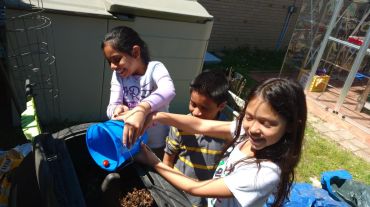 White Plains Church St Elementary Students are coming full circle. We Future Cycle just did a planting project with 4th grade using the schools own compost.
While recycling and placing their food waste into compost is now second nature to the students, the connection to what happens to that food waste and how it is used had not really been made.
Last spring, We Future Cycle implemented the second step of the program, which is tackling the classroom snack trash. Students are learning that food waste is not trash, but a valuable resource. Part of that program is to feed the apple cores and banana peels from snack also to compost. Last spring and this fall, students collected the organic snack waste in a little pail, brought it outside to the court yard and placed it into the composter, and now ….we got to harvest our first compost, going full circle.
We Future Cycle’s “Science of Compost” workshop explains the science behind food waste decomposition as well as its connection to healthy soils. Students got to examine closely different soil samples and make observation as to the fertility, ability to tilth, water retention and content of organic matter. We then planted seeds in normal garden soil, versus garden soil amended with their own compost. And now students are conducting scientific observation.
We Future Cycle is proud to have helped the Pelham Community Church to go green. One never knows how many moving parts a church operation has, until one tries to change direction. Under the skillful leadership of Pastor Noel Vanek, a consensus was built, with buy in from all parties as creating unity and ownership is what it takes to make any meaningful change permanent.
 We Future Cycle set up the building with clear signage, designed the flow of the material, trained the custodial staff, created information flyers for the other building users and already just days after roll out, a clear difference was visible.
 Aiming for Zero Waste, Pastor Vanek knew that organic recycling was a big factor and now the entrance to the church is sporting a 80 gal enclosed, rotating composter, with clear signage and a bin of leaves adjacent to it. While the church does not generate huge amounts of food waste, Pastor Vanek wants to be an example, to allow congregation members to witness that food waste composting is not “yuk” or “nasty”, but in fact super easy to do. The Church building is also home to a lovely nursery school and the children will also have the opportunity to place their banana peel into the composter and ….even more importantly….witness what has happened by the next time they open the composter again.
In fact, nearly 50% of all waste coming out of households is food waste, and it makes all the sense in the world to rather home compost that instead of treating it as garbage and spend energy on trucking it to the incinerator.
Pelham Community Church is well on their way to Zero Waste. What a wonderful example of building and improving community.




 We Future Cycle