Watching 5 and 6 year olds casually walking up to the recycling station and sorting their materials correctly into recycling, composting or trash is just so heart warming.
And how quick and normal these movements are now. While chatting with their friends, they empty their left over milk into the bucket to then place the carton into recycling. A quick glance onto their tray and they pick up their plastic cup to also put it into recycling. The snack bag goes into trash, they expertly empty their food scraps into compost and stack their trays.
This behavior is normal to White Plains students, and it diverts 95% of the lunchroom waste into reusable resources. Solving a problem by 95% by teaching a few changes in behavior. That is what it means to create a generation of kids that care.
Check out these involved K-students. Their job is to make sure that the trays at the recycling station are stacked properly, and ….-boy-….. do they take their job seriously. One is never too small to help create change.
In White Plains schools it is now normal behavior to clean up after lunch by carefully sorting your waste into recycling, non recycling and composting, thus diverting 95% away from garbage. Even the littlest ones know that and do it with care and consideration.
Supporting this behavior by elevating it into a “job”, thus creating a sense of responsibility and reiterating that we are all in the same boat is behind teaching even the littlest ones that their help matters.
Most schools in the US are part of the Federal School Lunch Program which regulates how tax payer dollars are spent on student lunches.
Thanks to Michelle Obama, real nutritional guidelines were put in place to assure that commercial food provider do not just use the cheapest of all ingredients to feed our littlest ones to pad their bottom line.
Extensive guidelines regulate the servings of fresh fruit, whole grain carbs, and fresh meat, but -as we all know- we are dealing with kids and some of the best intentions are not going to fly with them. So often enough, there are things they won’t eat despite all the best efforts.
Before WeFutureCycle got into the White Plains Schools, all those untouched food items would go straight into the garbage. The kids were served, didn’t open them, and off it went into the trash.
Now that we have taught students to separate their left overs into recyclable, compostable and non recyclable, we are also sorting out the untouched food items to repurpose them. Either as seconds for the older grades, or for the afternoon programs as snack or to the nurse for a snack. Anything is better than discarding perfectly untouched food, just because that particular student didn’t want to eat it.
We recently launched the WeFutureCycle recycling program in the Ben Turner Elementary school in Mount Vernon. This school has so impressed me with its outstanding lunchroom monitors.
Part of the recycling program is also to teach the kids to only take what they need, which means to not grab a stack of napkins at a time, or a whole handful of ketchup pouches.
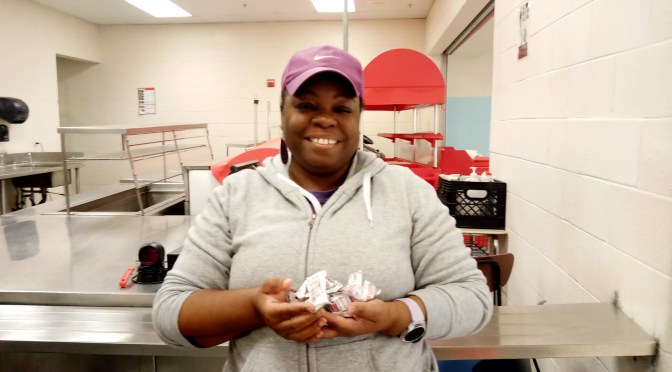
Making the right choices is a life lesson and lunch monitor Shantale Hughes is reinforcing that with her (very cute) charges. After her students have gotten their lunch, she helps them open their milk or other things and when she notices them having grabbed more pouches than needed, she collects them, so they do not become untouched garbage.
It takes a village to raise a child and Ms Hughes is clearly a very important part of the Ben Turner village. Thank you for going the extra mile.
Meet Crystal Beattie, a food service lead in a Westchester school district for the past 9 years. She makes cooking for 500 students look easy and she is one of the few schools that offers hot breakfast like those yummy sausage egg and cheese sandwiches in the cafeteria.
While offering breakfast in the lunchroom may have logistical challenges to fit all students into a relatively narrow time window, it comes with the great advantage of being able to offer a hot breakfast menu and also keeping all food and waste in the lunchroom, rather than in the individual classrooms.
Most school districts participate in the National School Lunch Program, established in 1946 under President Truman. This program helps public schools to provide low cost or free lunches to students. About 7.1 million children participated in the NSLP in its first year. Since then, the program has reached millions of children nationwide: 1970: 22.4 million children; 1980: 26.6 million children; 1990: 21.1 million children; 2000: 27.3 million children; 2010: 31.8 million children; and 2016: 30.4 million children.
During the pandemic all schools became eligible for free breakfast and free lunch and meals were then served in the individual classrooms to limit student contacts.
That meant for Food Service providers to heavily rely on commercially available, individually wrapped food items with long shelf life. And that means of course mountains of packaging garbage and food scraps in each of those classrooms. And milk spills in the classrooms, and food scraps on the floor, and an extra garbage run through every classroom by the custodial staff, replacing plastic bags in each classroom….
Can you just see the amount of labor, materials and garbage attached to this issue?
A typical breakfast in the classroom consists of a plastic bag that contains a plastic wrapped starch (bagel, muffin, granola bar or cereal) , fruit juice or milk carton and sometimes a jogurt. Food service staff will fill these items into bags, then knot them, then place them into individual tubs that will be brought up to each classroom. Students usually grab a bag, or open one on the spot to just remove the one item they want to eat and all the rest will go either in the garbage in the classroom, or will make its way down to the kitchen to be discarded there into the garbage.
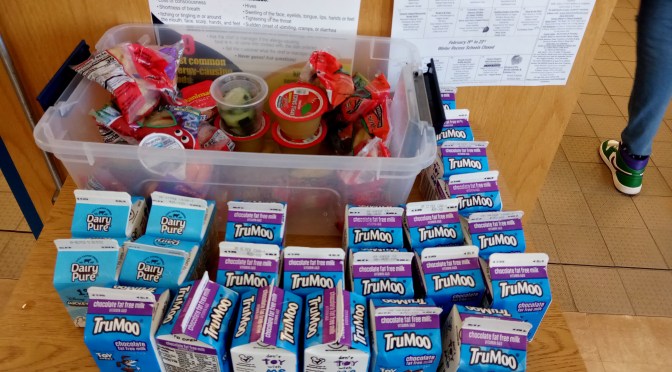
The untouched food waste is just staggering, here is an example of returned breakfast items on one day from a school with 500 students.
Bringing breakfast back into the lunchroom has many advantages
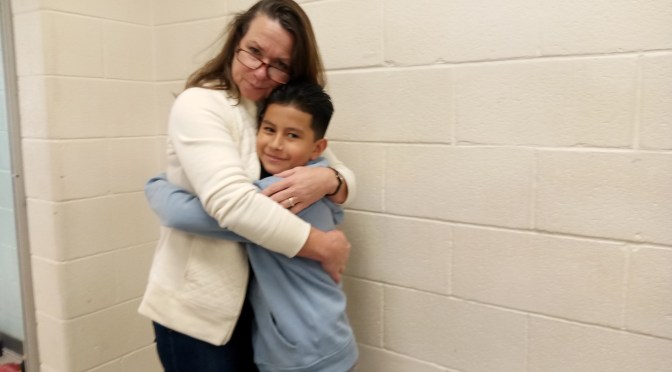
” Thank you for teaching us about saving the world”.
This heartwarming sentence, accompanied by a hug came from a 5th grade boy in the Ben Turner Elementary school in Mount Vernon.
This week we rolled out the WeFutureCycle recycling program at this school and taught the students in grade by grade presentation about where the garbage goes and how simple, small changes can make such a difference. Students learned about how garbage from the street makes it into the ocean. An audible collective groan went through students seeing how plastics enter the food chain and ultimately kill animals.
Teaching students that their actions can make a difference, little tiny changes of daily routines add up for positive change. It was heart warming to be hugged by these youngsters for teaching them that they have the power to make change.
We Future Cycle just rolled out the comprehensive recycling program at the Mount Vernon Steam Academy, a 9-12 HighSchool with a population of 800 students, all future engineers, doctors and astronauts. As preparation for the student roll out, we presented the advantages to the adults including security, food service and custodial staff.
Because it takes a village to raise a child.
Meet Ivey Reid, the exceptional food service lead for the past 11 years. Ms Reid took to the program like a fish to water and decided on day one that she can go the extra mile in her kitchen in terms of waste diversion. Normally, the kitchen will sort out commingled and compostable materials, but this most fabulous lead also started to sort out clean clear soft plastic that would be recycled as plastic film at grocery stores, the resource needed for Trex decking materials.
And she made it look easy. A clear bag tied to the corner of a shelf, a quick explanation to her entire staff and off they went, and the result is a diversion rate of 97% in the kitchen, including a large bulging bag of clear cling plastic that otherwise would have been trashed and ultimately burnt into the air we breathe. Way to go!
How does one change the world? Easy, by changing the minds of people. And how does one change the mind of someone? By showing them that small personal actions can have a huge positive ripple effect through the community.
WeFutureCycle’s mission statement is “Creating a generation of kids who care” and we believe that if we teach students in schools that their small actions matter, we can change the world, one school at a time.
Every day participating students are sorting their waste carefully into recycling, compost and trash, thus diverting 90+% out of the garbage stream.
Think about that….90+% of a problem solved by a quick hand movement.
And the ripple effect through the community is that these kids bring these behavioral changes home and are starting to change the world, one household at a time.
There are two concern that make school leaders hesitant to start lunchroom recycling & composting.
The first concern is the fear of change. Administrators and custodians are worried that a source separate program, where students are separating their milk cartons, plastics, and food waste, will create more work in the lunchroom, and that sorting lunchroom leftovers may be too challenging for their students. However, as more schools have adopted the We Future Cycle program, and enhanced recycling and composting has taken off in Westchester, these concerns have subsided. School leaders realize that composting is an important part of a healthy community, and they are now fully on board at the start.
The second concern is money. While implementing and maintaining a recycling and composting program at a school is minuscule compared to many school expenses, every penny counts. We try to use existing bins at the school because reusing is both economical and sustainable. However often some bins need to be purchased, along with signage to specficy the separation of milk and juice cartons, food waste, etc. Annual recycling & compost pick up costs several thousand dollars per year. And We Future Cycle must charge a nominal fee to maintains school-required insurance and ensure we can bring in enough people to help educate students and monitor recycling bins at an ever-growing number of schools as we expand our reach. Volunteers are wonderful, but most districts do not have a sufficient number of stay-at-home parents who can dedicate enough time to helping us launch and sustain our programs.
What is a school to do? Enter Carton Council, willing to contribute funds for bins and signage for milk & juice carton recycling, which makes the We Future program a reality at many schools!
Formed in 2009, the Carton Council is an organization committed to growing carton recycling in the U.S. By promoting both recycling technology and local collection programs, as well as growing awareness that cartons are recyclable, they work to limit the number of cartons that become waste. Since Westchester County’s Material Recycling Facility (MRF) began recycling milk cartons and Tetra Pak containers in May 2016, the Carton Council’s mission to increase carton recycling and We Future Cycle’s mission to increase lunchroom recycling and composting were perfectly aligned.
Carton Council grants have been provided to schools in Rye Neck and Mount Vernon. New schools that join the We Future Cycle family will have the option to obtain a Carton Council grant as well. We are seeing that the grants are having a huge impact on schools’ abilities to work with us, and we are enormously grateful to the Carton Council for making our program a reality at so many Westchester schools!






 We Future Cycle